- Case study
- Morocco
- SEO
- Next.js
Clinic website design: more appointments, fewer phone calls
Clinic website design that works: one page per specialty for Google, an FAQ that answers before the phone rings, and online appointment requests. With a real clinic in Marrakech.
On this page
- Why does a clinic need its own website?
- What pages should a clinic website have?
- What goes on a specialty page?
- A real example: Clinique Chifa Tasnime in Marrakech
- How do patients book an appointment online?
- Appointment request or online calendar?
- What should a clinic website ask patients, and what shouldn't it?
- Which details reassure a patient?
- How much does clinic website design cost?
- Do you run a clinic or a medical practice?
- Frequently asked questions
Key takeaways
- Good clinic website design gives each specialty its own page, so each one can answer its own Google search.
- An FAQ on insurance, payment and visiting hours answers the repeat questions before patients call reception.
- Start with an appointment request that reception confirms; an online calendar only makes sense when doctors' schedules are kept up to date.
- The booking form asks only what the clinic needs to call the patient back, never their medical file.
Good clinic website design comes down to three things: a page for each specialty so patients find you on Google, answers to the usual questions before anyone picks up the phone, and an appointment request that takes a minute. Here is the method I use, page by page, with a real example: the website I developed for a private clinic in Marrakech.
Why does a clinic need its own website?#
Ten past eight on a Monday, and the front desk phone is already ringing. "Are you open on Sunday? Do you have a cardiologist? Where exactly are you?" While the receptionist answers, a second line rings, and a third caller is on hold, probably with the same three questions.
Patients search before they call, usually on a phone, sometimes in the middle of the night. If someone types "cardiologist Marrakech" and lands on your cardiology page, with what you do and a "Book an appointment" button, they contact you. If they land on a directory listing with an old number, they call the clinic down the road.
A clinic website doesn't replace your reception. It takes the repeat questions off their desk, so they can look after the patients standing in front of them.
What pages should a clinic website have?#
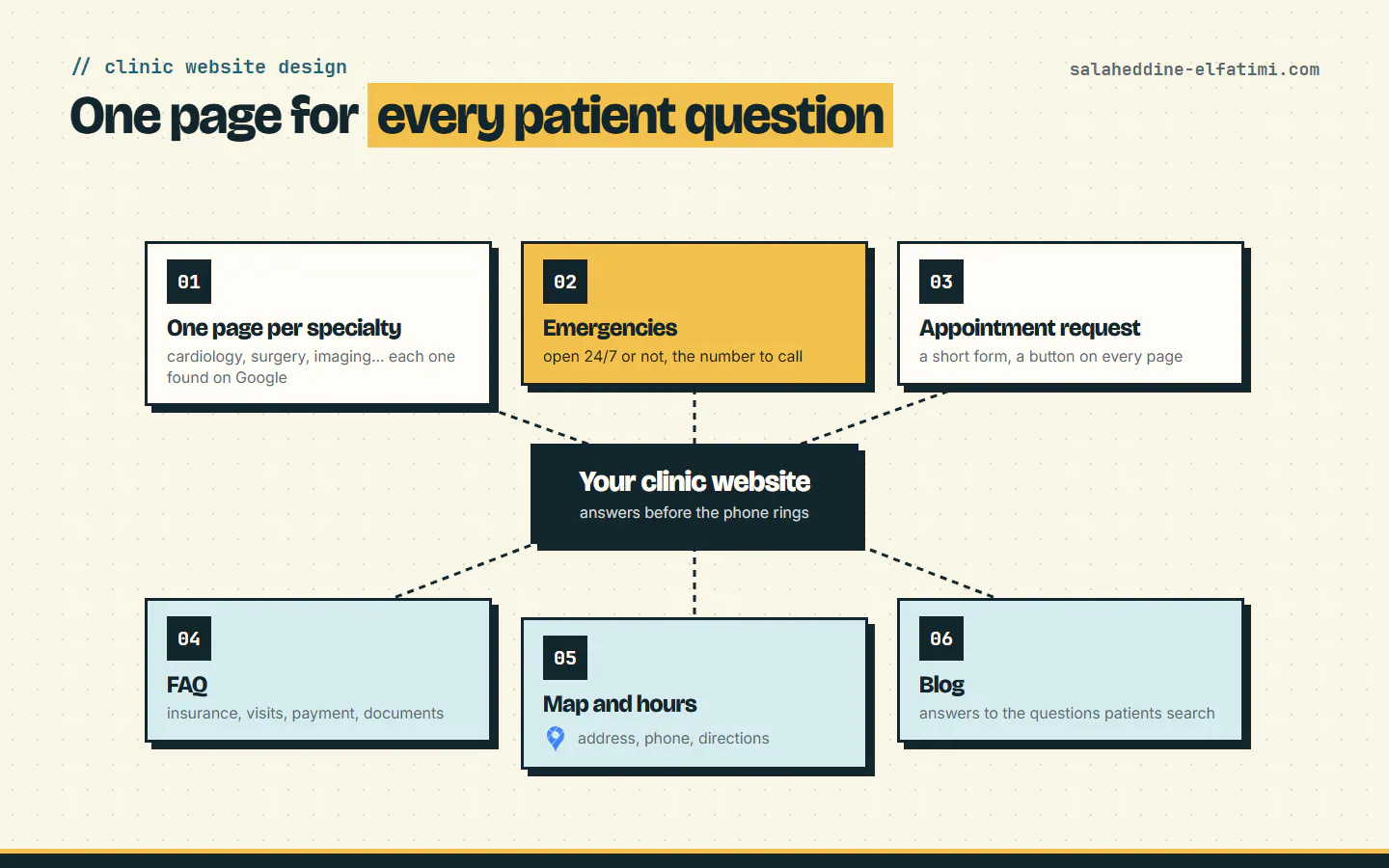
The classic mistake in clinic website design is a single "Our services" page that lists everything. Google can't show that one page for "pulmonologist Marrakech" and for "emergency clinic Marrakech" at the same time. You need one page per specialty, plus the pages every patient looks for:
- One page per specialty: what is treated, the tests and equipment, and the team if the doctors agree to appear.
- Emergencies, easy to find: open 24/7 or not, the number to call, and whether patients need an appointment (for emergencies, they shouldn't).
- An appointment request: a short form, with a button on every page.
- An FAQ: insurance, payment, visiting hours, what to bring.
- Contact, map and hours: the address, a map and a phone number you can tap. A worried patient should never have to hunt for it.
- A blog, when someone at the clinic has time to write: short answers to questions patients actually search.
What goes on a specialty page?#
In clinic website design, the specialty page does the heavy lifting. It answers one question: "can this clinic take care of my problem?" So it lists the concrete things a patient can come for, in plain words, and ends with a way to book.
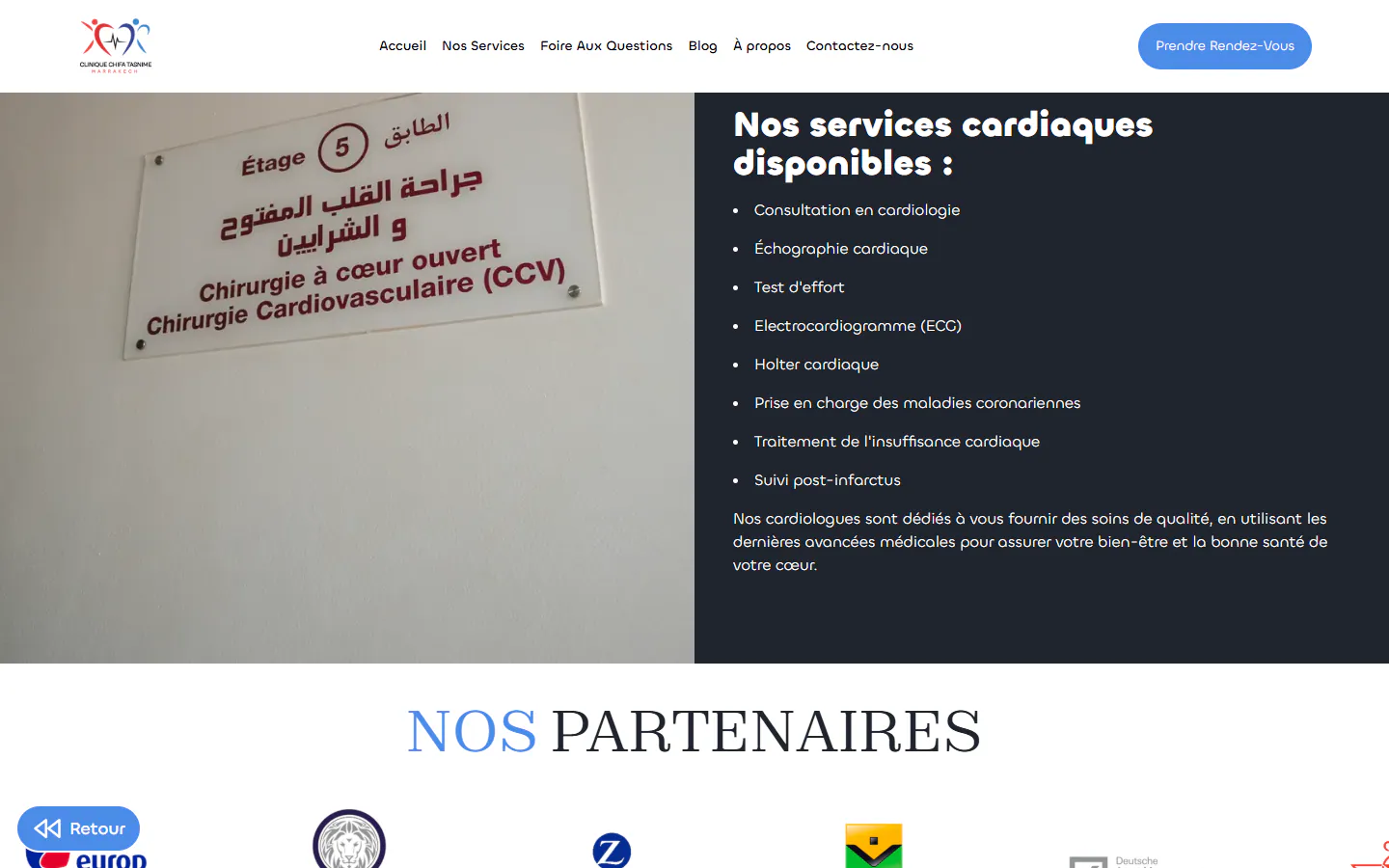
The cardiology page I built for Clinique Chifa Tasnime is a good example. It lists eight services, from the cardiology consultation and the cardiac ultrasound to the stress test, the ECG and the Holter monitor, then answers seven questions patients ask about them, such as "is a cardiology consultation painful?". A patient reads it and knows what to expect before walking in.
A real example: Clinique Chifa Tasnime in Marrakech#
Clinique Chifa Tasnime is a private clinic in Marrakech. I developed its website, in French, while I was at the Trafic Genius agency. The home page shows seven specialties, each linking to its own page: surgery, cardiology and rhythmology, pulmonology, traumatology and orthopaedics, radiology and imaging, emergencies and intensive care (24/7), and interventional cardiology with cardiovascular surgery.
Around them sit an FAQ page with ten questions (insurance, payment methods, visiting hours, health check-ups…), an about page, a blog, and a contact page with the address, phone, email and a Google map. The emergency page says it plainly: open 24 hours a day, 7 days a week, and no appointment needed.
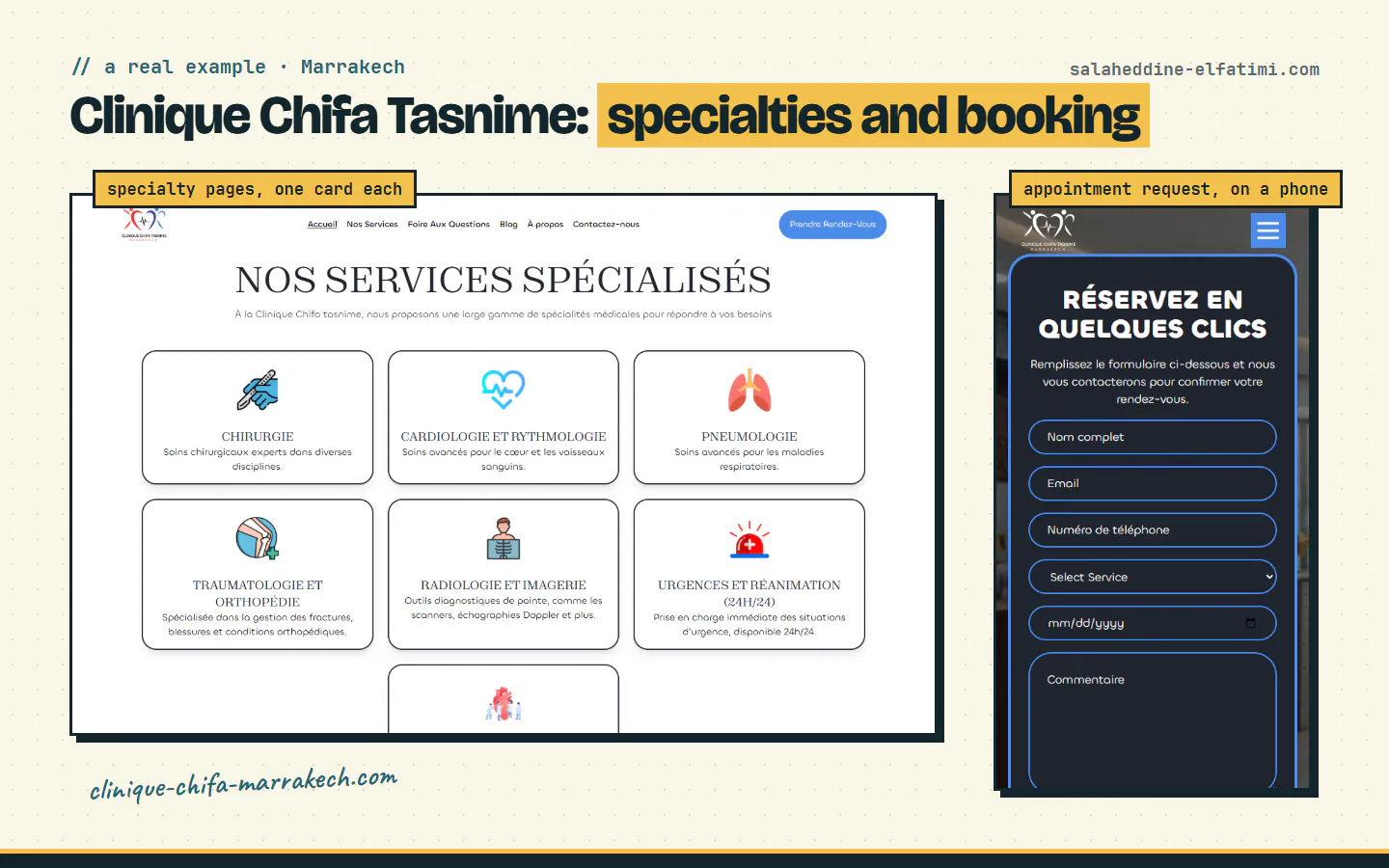
The appointment page asks for the essentials: full name, email, phone number, the service, a preferred date and a comment. The patient sends the request, and the clinic contacts them to confirm. The "Prendre Rendez-Vous" (book an appointment) button sits in the header of every page, so nobody has to look for it.
How do patients book an appointment online?#
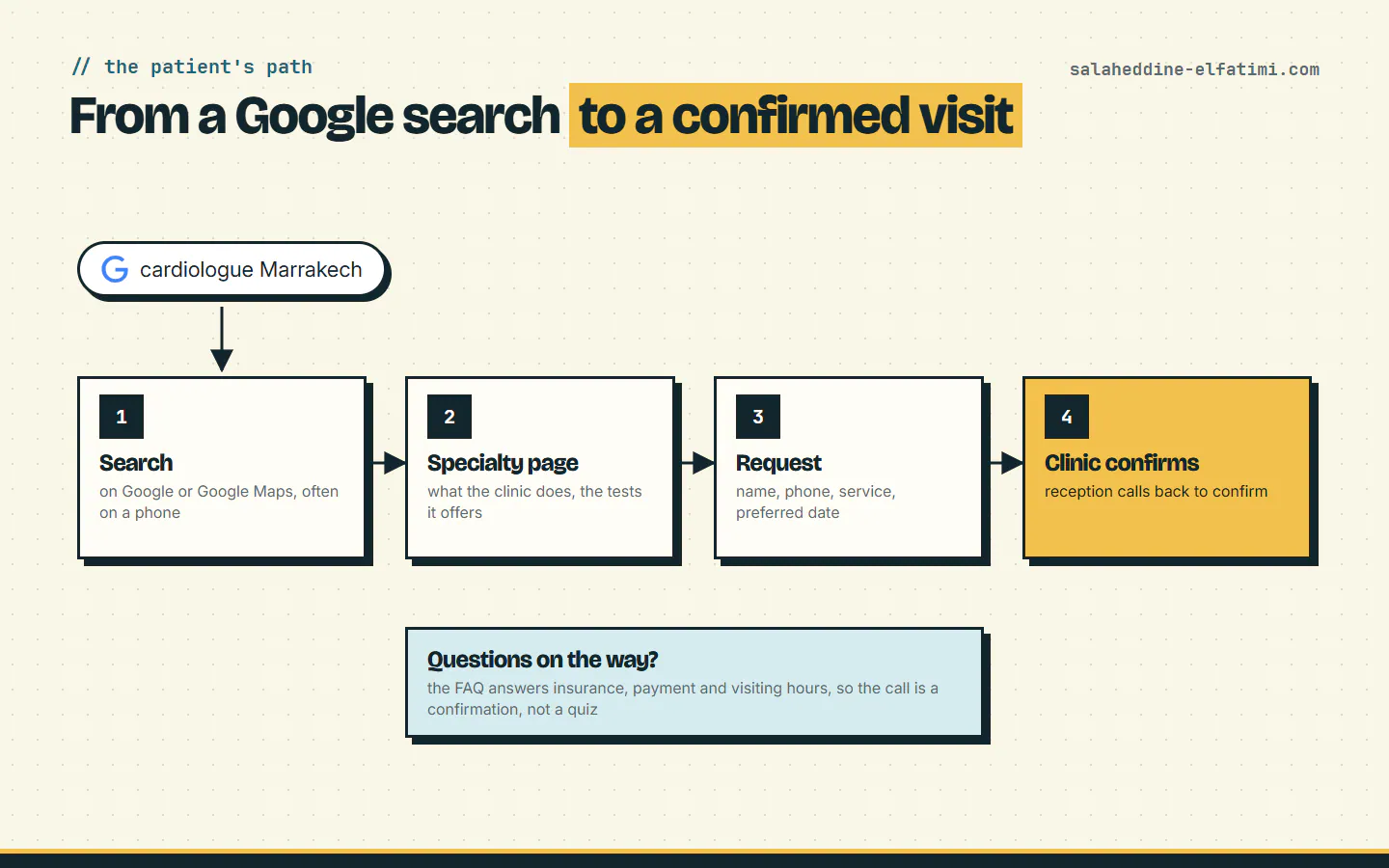
- They search "cardiologue Marrakech" or "emergency clinic Marrakech", on Google or Google Maps.
- They land on the specialty page, which explains what the clinic does.
- They check the FAQ for the practical questions: insurance, payment, visiting hours.
- They send an appointment request: name, phone, service, preferred date.
- Reception calls back and confirms. The patient chose your clinic before setting foot in it.
Appointment request or online calendar?#
For most clinic website design projects, an appointment request is the right start: the patient suggests a date, and reception confirms it against the doctors' schedules. It's simple, and you stay in control of the planning.
An online calendar, where patients pick a free slot themselves, only works if every doctor's schedule is kept up to date in software. It's more comfortable for the patient when it's reliable. When it isn't, it's worse than a form: a booked slot that doesn't exist is a very awkward conversation at the front desk.
What should a clinic website ask patients, and what shouldn't it?#
A clinic website touches sensitive information. In Morocco, personal data is covered by Law 09-08, overseen by the CNDP; other countries have their own rules. I'm not giving legal advice here, but this is the rule I follow: the form asks for what the clinic needs to call the patient back, not for their medical file.
- No test results or prescriptions sent through the form: those belong in the consultation.
- A short comment field, so the patient can explain their request if they want to.
- The site served over HTTPS, and requests sent only to the people who handle them.
Which details reassure a patient?#
- Real photos of the clinic: reception, rooms, equipment. Patients want to see where they're going.
- Fast on a phone: people often search on mobile data, sometimes in a hurry. The Chifa site is built with Next.js.
- Your Google Business Profile, linked to the website: it's what shows on Google Maps. A QR code at reception can send happy patients there to leave a review; my free Google review QR code generator makes one in a minute.
- Your patients' languages: French in Morocco, plus Arabic or English if part of your patients reads them more easily.
- The emergency number at the top of the page, tappable on a phone.
The same idea, one page per thing people search, works for other businesses too: I apply it to riad and hotel websites and to restaurant websites. If you'd rather read this in French, here is the French version for clinics in Morocco.
How much does clinic website design cost?#
The price of clinic website design depends on the number of specialties, the languages and how booking works. A site with a page per specialty and an appointment request form costs much less than one connected to a medical calendar. A first version with the essentials starts from about $1,000, and each extra module is quoted separately.
Do you run a clinic or a medical practice?#
Send me your current website, or your Google Maps listing if you don't have one yet, with the list of your specialties. I'll reply with the pages to create and a quote: ask for a quote here. You can also see what I build for clinic and business websites.
Frequently asked questions
What pages should a clinic website have?+
One page per specialty, an emergency page, an appointment request page, an FAQ, and contact details with the address, a map, the hours and a phone number. A blog helps if someone at the clinic can write for it.
How do patients book an appointment on a clinic website?+
The simplest way is a request form: name, phone, service and preferred date, then reception calls back to confirm. An online calendar where patients pick a slot needs schedules that are always up to date.
Should a clinic website ask for medical information?+
Keep the form to what the clinic needs to call the patient back. Test results and prescriptions belong in the consultation. In Morocco, personal data is covered by Law 09-08, overseen by the CNDP.
How much does a clinic website cost?+
It depends on the number of specialties, the languages and the booking system. A first version with the essentials starts from about $1,000, and each extra module is quoted separately.

Written by
Full Stack Developer & Web Marketer · Marrakech, Morocco
I build modern, scalable web applications end to end, from frontend to backend, with a focus on performance, clean code and user experience.