- Case study
- Morocco
- SEO
- Next.js
Restaurant website in Morocco: what to put online to fill your tables
A restaurant website for Morocco: the menu as a web page, one page per cuisine, hours, map and table booking, linked from Google. With a real example from Marrakech.
On this page
- Does a restaurant need a website if it's on Google Maps and Instagram?
- What pages should a restaurant website have?
- Menu as a PDF or as a web page?
- A real example: the Caravan Serai restaurants in Marrakech
- How do guests book a table?
- Connect the website to Google
- The details that make guests come
- How much does a restaurant website cost?
- Do you run a restaurant in Marrakech or elsewhere in Morocco?
- Frequently asked questions
Key takeaways
- Google Maps and Instagram bring guests; a restaurant website answers the menu, price, hours and booking questions before they call.
- Put the menu on a web page with every dish and its price, not in a PDF: it reads well on a phone and Google can find it.
- Give each cuisine or space its own page so it can appear for its own search, like "tagine restaurant Marrakech".
- Link the menu page from your Google Business Profile, and start table booking with what you'll answer: phone, WhatsApp or a form.
A good restaurant website answers the questions guests ask before they call: what's on the menu, how much it costs, when you're open and how to book a table. It gives each cuisine its own page so Google can show it, and it puts the menu on a real web page instead of a PDF. Here is the method I use for restaurants in Morocco, with a real example from Marrakech.
Does a restaurant need a website if it's on Google Maps and Instagram?#
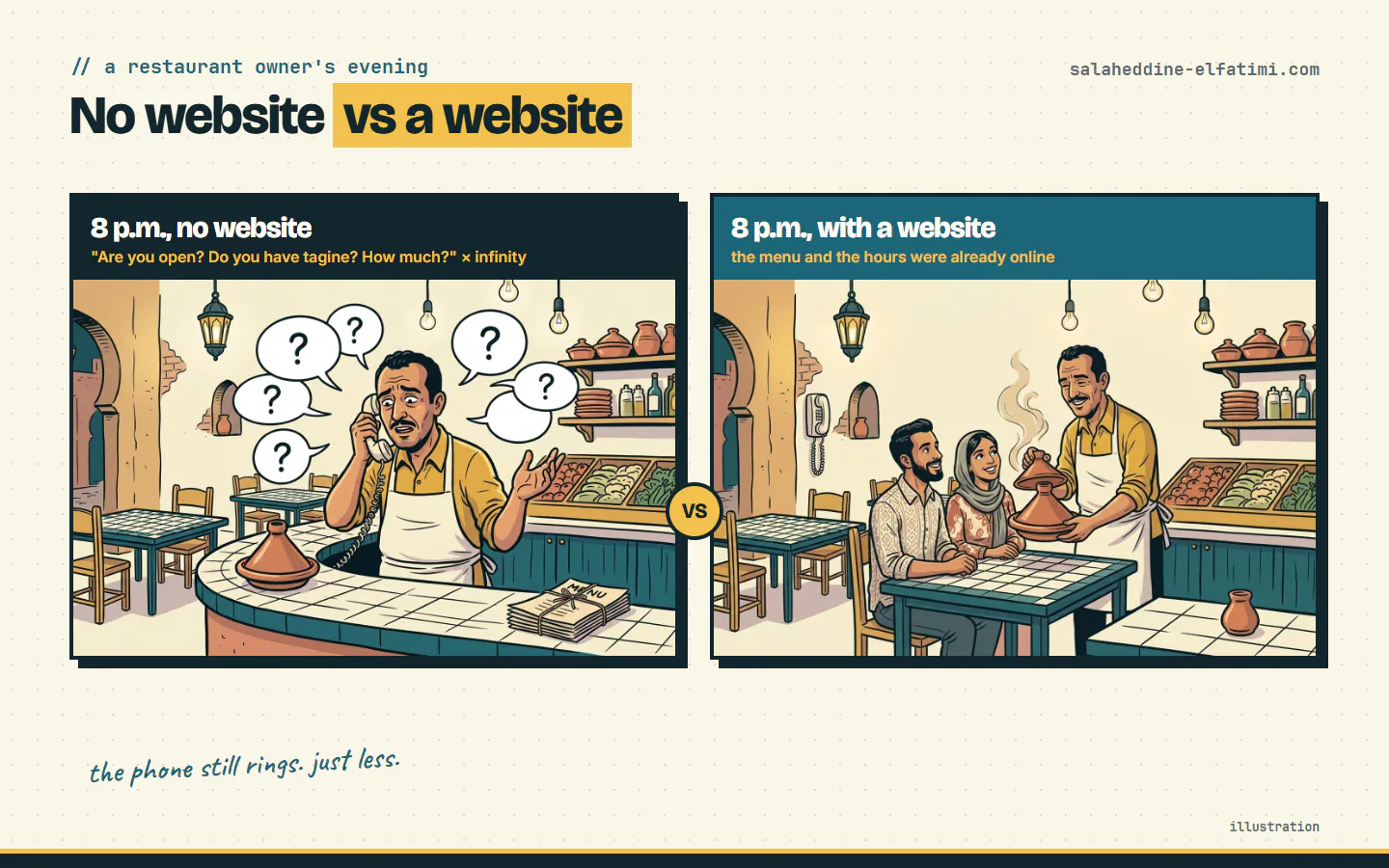
Eight in the evening. The phone rings: "Are you open tonight? Do you have tagine? How much is it?" You answer, hang up, and it rings again with the same three questions.
Google Maps and Instagram are great at one thing: making people discover you. A photo of a tagine on Instagram makes someone hungry. A pin on Google Maps tells them you're close. But neither one holds your full menu with prices, explains your French dishes next to your Moroccan ones, or tells a tourist which door to take in the medina.
That's the website's job. Maps and Instagram bring guests in; the website answers them. And the guests who read your menu before calling are the ones who already decided to come.
What pages should a restaurant website have?#
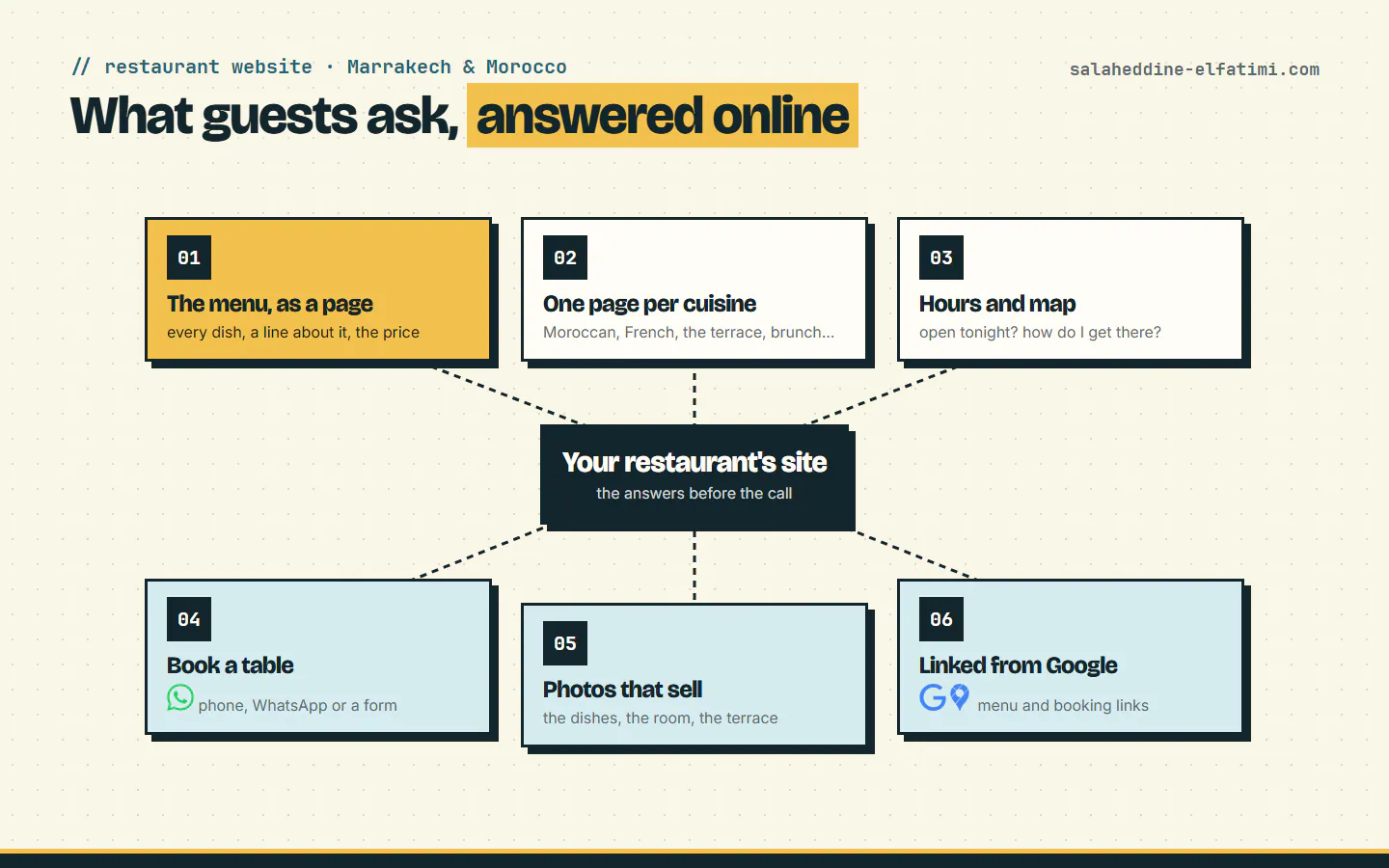
A restaurant website doesn't need many pages. It needs the right ones, each answering one question:
- The menu, as a web page: every dish with one line about it and its price. Starters, main courses, desserts, drinks.
- One page per cuisine or space: Moroccan and French, the terrace, the brunch, the private room. Each one can show up on Google for its own search.
- Hours and a map: open days, opening times, the address and a map. In the medina, add how to reach you from a landmark everyone knows.
- How to book a table: a phone number you can tap, a WhatsApp link, or a short form.
- Photos: the dishes, the room, the terrace. A restaurant sells with the eyes first.
- About and contact: your story in a few lines, and every way to reach you.
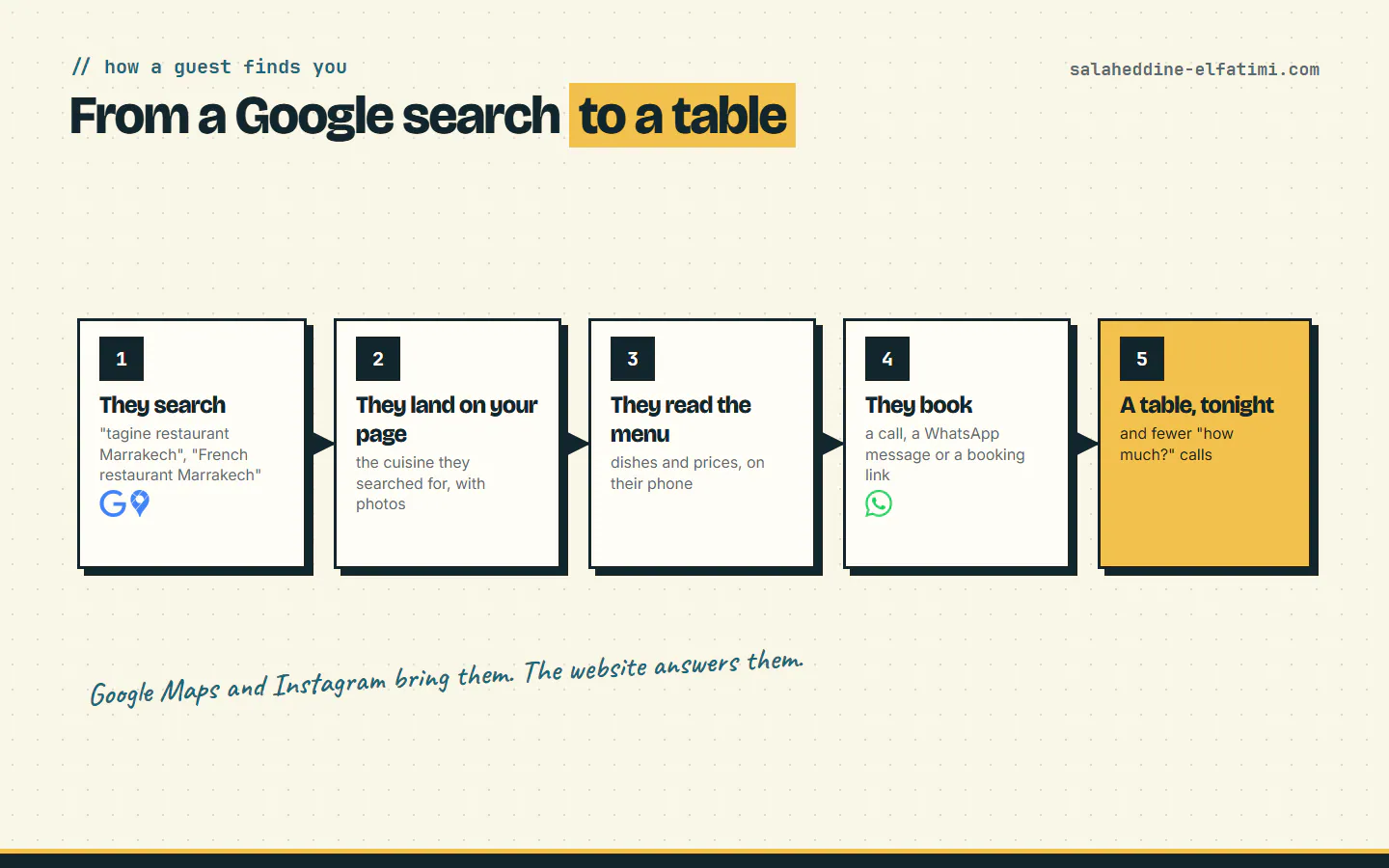
Someone looking for dinner doesn't type your restaurant's name. They type "tagine restaurant Marrakech" or "French restaurant Marrakech", and the page that matches is the one Google shows.
Menu as a PDF or as a web page?#
A web page, every time: for me, the menu is the page that matters most on a restaurant website. A PDF menu has to be downloaded and zoomed on a phone, and Google reads it badly. A menu written as a page loads in a second, reads well on a small screen, and every dish on it is text Google can find.
It's also easier for you: change a price or add a dish of the day, and it's live. No new PDF, no old one still circulating on WhatsApp with last year's prices.
A real example: the Caravan Serai restaurants in Marrakech#
Caravan Serai is a hotel and spa in Marrakech with two restaurants. I developed its website, and the restaurants get the same treatment as the rest of the site: each one has its own page.
- The Moroccan restaurant page: the signature dishes (tagines, couscous royale, grilled mechoui, harira), the desserts and mint tea, and the setting, in the courtyard or the indoor room.
- The French restaurant page: foie gras, onion soup, filet de bœuf au poivre, salmon en papillote, and the classic desserts.
- A separate menu page: starters and main courses, each with a line of description and a price in dirhams. The chicken tagine with preserved lemon and olives is 110 DHS; the Caesar salad, 70 DHS.
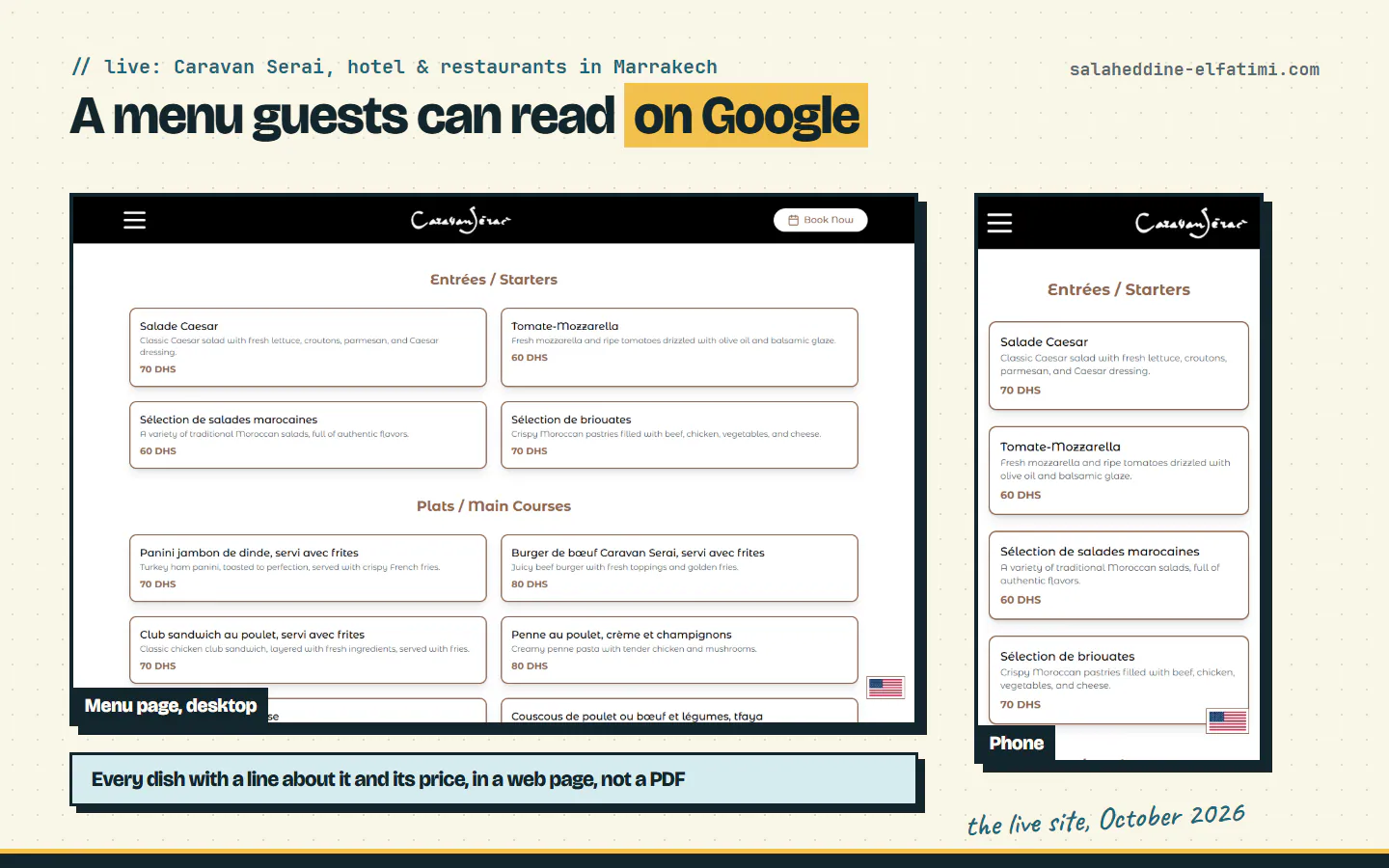
One honest detail: those pages don't have an online table booking. Guests book by phone or email, shown on every page. For many restaurants that's exactly right; you'll see why below.
How do guests book a table?#
There are three ways, from the simplest to the most complete:
- A phone number you can tap. On a phone, one tap calls you. Free, and often enough for a small restaurant.
- A WhatsApp link. One tap opens a chat with your number. Guests in Morocco already use it, and you answer when you have a minute.
- A booking form or platform. Date, time, number of guests. Useful when you're full most evenings and want the bookings written down in one place.
Start with what you'll actually answer. A form nobody checks is worse than a phone number that rings.
Connect the website to Google#
Your Google Business Profile is what appears on Google Maps. According to Google's own help page, a profile can include one link for customers to check a menu, and up to 10 links per category to book, make a reservation or place a food order.
That menu link should point to your menu page. A guest who finds you on Maps taps it and lands on your dishes and prices, not on a blurry photo of a paper menu. And once they've eaten, a QR code on the table can bring them back to Google to leave a review: here's my free Google review QR code generator.
The details that make guests come#
- Fast on a phone. Most people look for a restaurant on their phone, often outside, on mobile data. The Caravan Serai site is built with Next.js to load quickly.
- Your guests' languages. In Marrakech, that's often English and French, sometimes Arabic or Spanish. The menu in the guest's language is the menu they read to the end.
- Real photos. Your dishes and your room, not stock pictures. Guests recognise the difference.
- The questions on the page. Terrace? Alcohol? Vegetarian dishes? Parking? Each answer on the page is one call fewer.
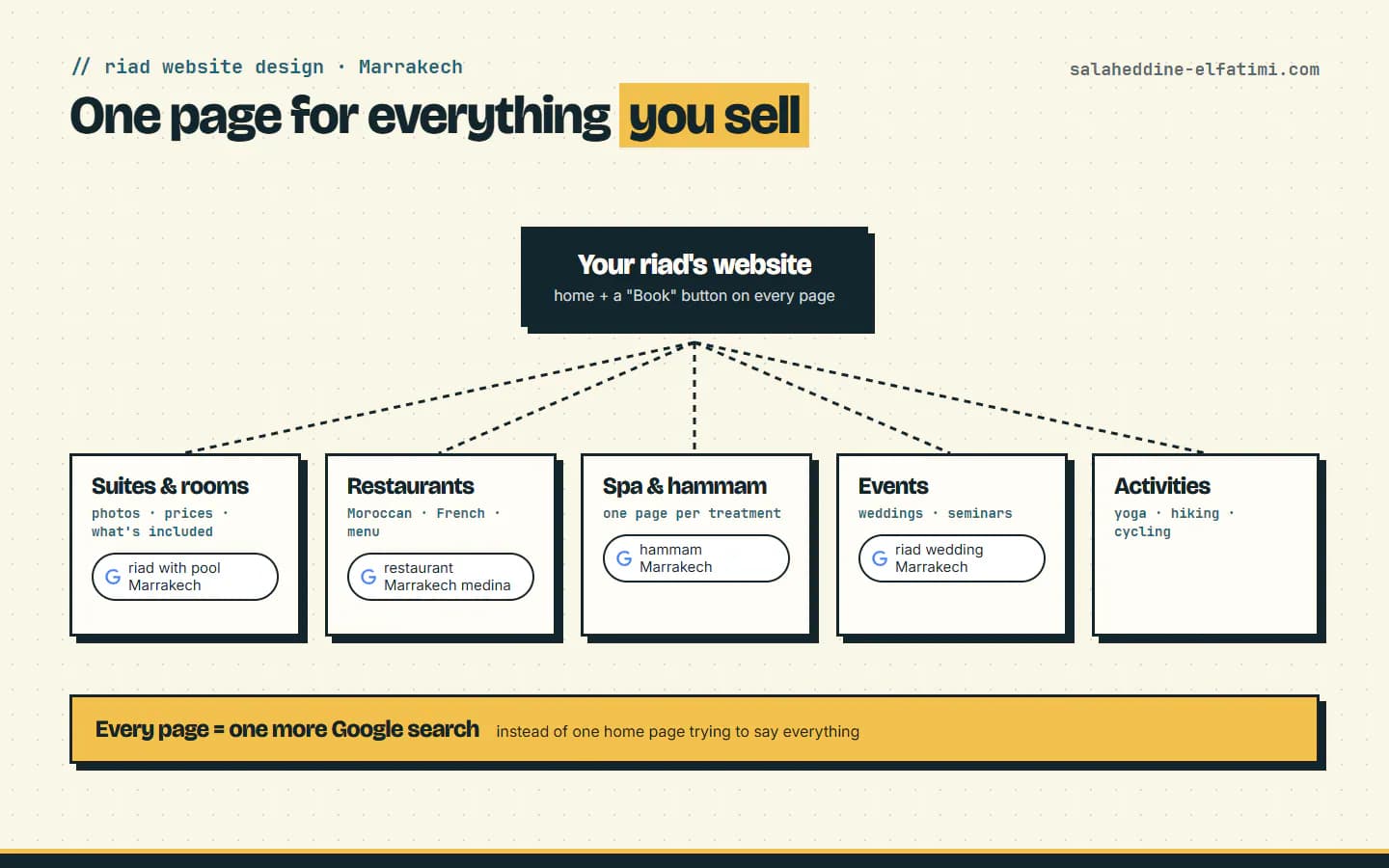
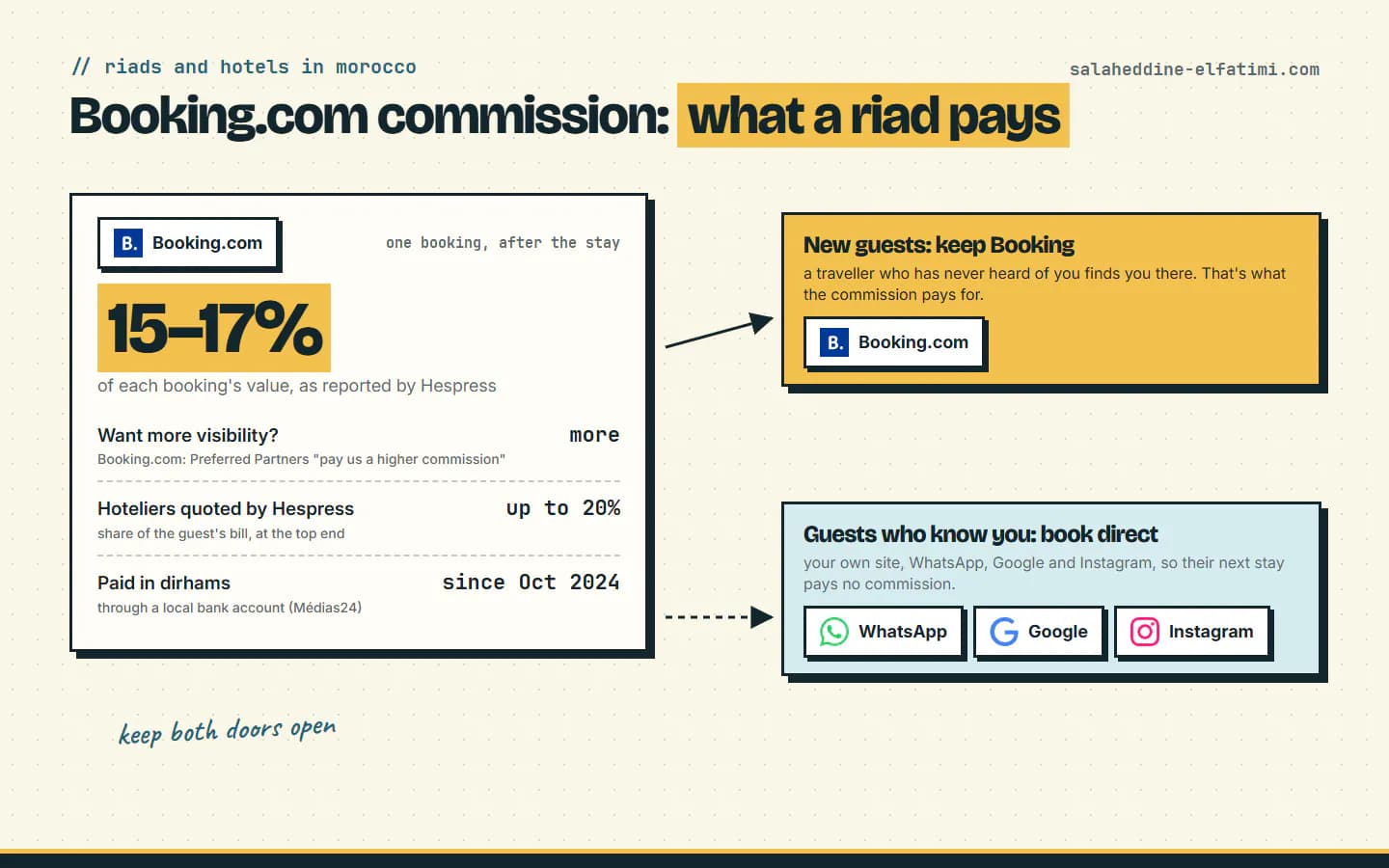
If your restaurant is inside a riad or a hotel, the same idea applies to the whole place: one page for each thing you sell. I explain it in riad website design, and why direct bookings matter in Booking.com commission in Morocco.
How much does a restaurant website cost?#
It depends on the number of pages, the languages and how bookings work. A site with the essential pages, the menu and a phone or WhatsApp booking costs much less than one connected to a booking platform. A first version with the essentials starts from about $1,000, and each extra module is quoted separately; here is how I price a project, module by module.
Do you run a restaurant in Marrakech or elsewhere in Morocco?#
Send me your restaurant's link, or your Google Maps or Instagram page if you don't have a site yet, and tell me what you serve. I'll reply with the pages to create and a quote: ask for a quote here. You can also see what I build for business websites and the projects I've delivered.
Frequently asked questions
Does a restaurant need a website if it's on Google Maps and Instagram?+
Google Maps and Instagram help people discover you, but they don't hold your full menu with prices, your opening hours and your booking options in one place. A website answers those questions before guests call, and Google can show each page for its own search.
Should a restaurant menu be a PDF or a web page?+
A web page. It loads fast and reads well on a phone, Google can read every dish on it, and you can change a price in a minute without sending a new PDF around.
How can guests book a table on a restaurant website?+
With a phone number they can tap, a WhatsApp link, or a booking form or platform. A small restaurant can start with the phone and WhatsApp; a form helps when you're full most evenings.
How much does a restaurant website cost in Morocco?+
It depends on the pages, the languages and the booking system. A first version with the essential pages and the menu starts from about $1,000, and extra modules are quoted separately.
Written by
Full Stack Developer & Web Marketer · Marrakech, Morocco
I build modern, scalable web applications end to end, from frontend to backend, with a focus on performance, clean code and user experience.