TypeScript 7 is out: the compiler rewritten in Go, 10× faster
TypeScript 7 is out with a compiler rewritten in Go: 8× to 12× faster builds by Microsoft's numbers. What changes, how to install it, and the catch before you upgrade.
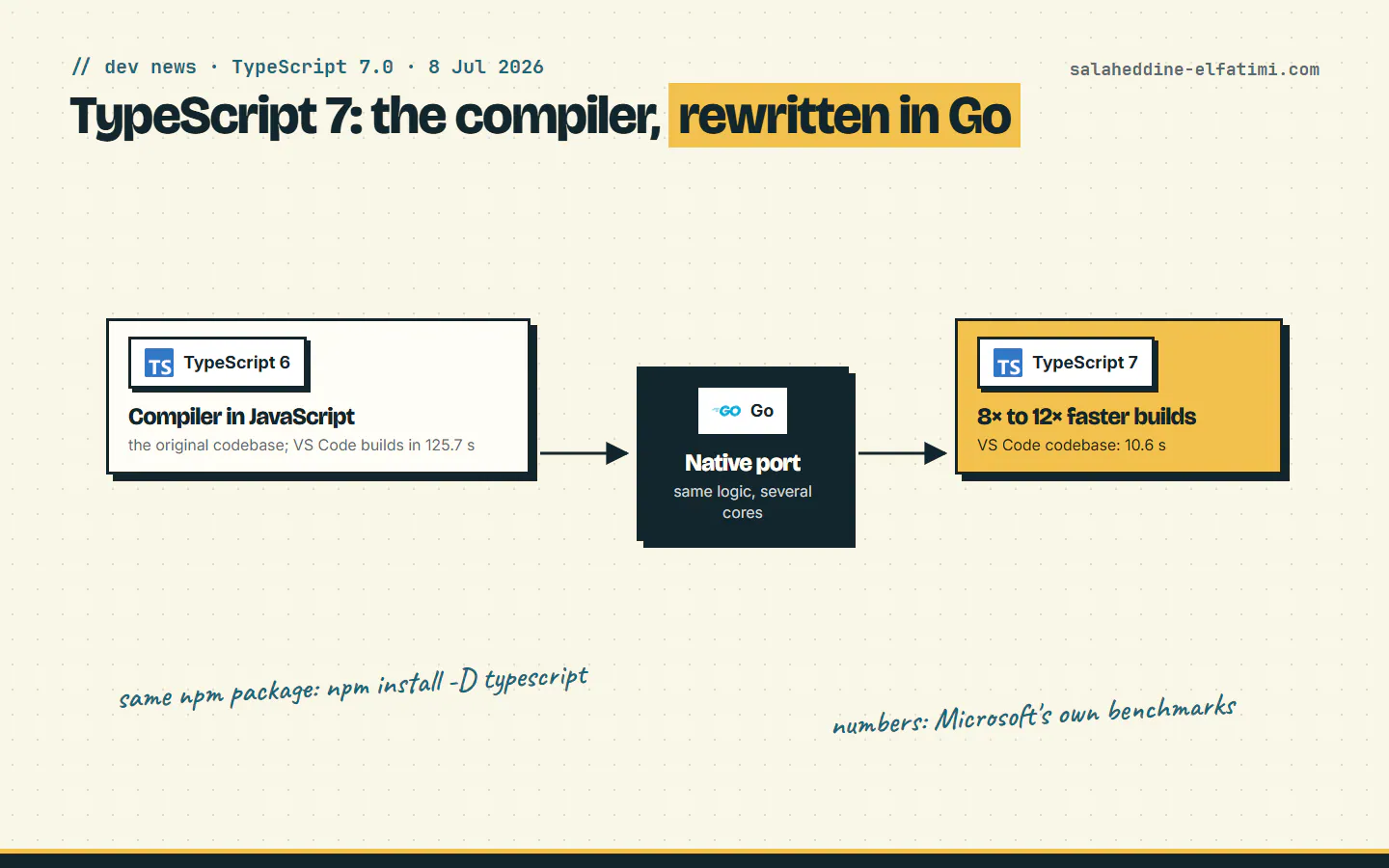
TypeScript 7.0 (8 July 2026) is the TypeScript compiler ported to Go, with native speed and multithreading.
By Microsoft's benchmarks, full builds are 8 to 12 times faster: the VS Code codebase builds in 10.6 s instead of 125.7 s.
You install it as before with npm install -D typescript; nothing changes in your code.
7.0 has no programmatic API until 7.1, so keep TypeScript 6 (tsc6) alongside for typescript-eslint.
Frequently asked questions
Is TypeScript 7 written in Go?+
Yes. TypeScript 7 is a native port of the compiler to Go, keeping the original structure and logic so both give the same results, with native code speed and multithreading.
How much faster is TypeScript 7?+
Microsoft reports 8 to 12 times faster full builds. Their examples: the VS Code codebase from 125.7 s to 10.6 s, and the first editor error from about 17.5 s to under 1.3 s.
Does typescript-eslint work with TypeScript 7?+
TypeScript 7.0 has no programmatic API, so typescript-eslint still needs TypeScript 6. Install @typescript/typescript6 through an npm alias and keep it next to TypeScript 7 until 7.1.
How do I install TypeScript 7?+
Run npm install -D typescript, then npx tsc. Nightly builds are available with npm install -D typescript@next.
Written by
Full Stack Developer & Web Marketer · Marrakech, Morocco
I build modern, scalable web applications end to end, from frontend to backend, with a focus on performance, clean code and user experience.
TypeScript 7 is out, and its compiler is now written in Go. Microsoft ported the whole type-checker to native code that runs on several CPU cores, and by their numbers full builds are 8 to 12 times faster. You install it the same way (npm install -D typescript), but 7.0 ships without a programmatic API, so tools like typescript-eslint still need TypeScript 6 next to it.
TypeScript 7.0 is a native port of the TypeScript compiler, released on 8 July 2026. The team rewrote the code in Go while keeping the structure and logic of the original, so both compilers give the same results. What changes is the speed: native code, shared-memory multithreading, and parsing, type-checking and emitting running in parallel.
You don't change your code or your tsconfig. It's still the language you write every day; only the tool that checks and builds it got faster.
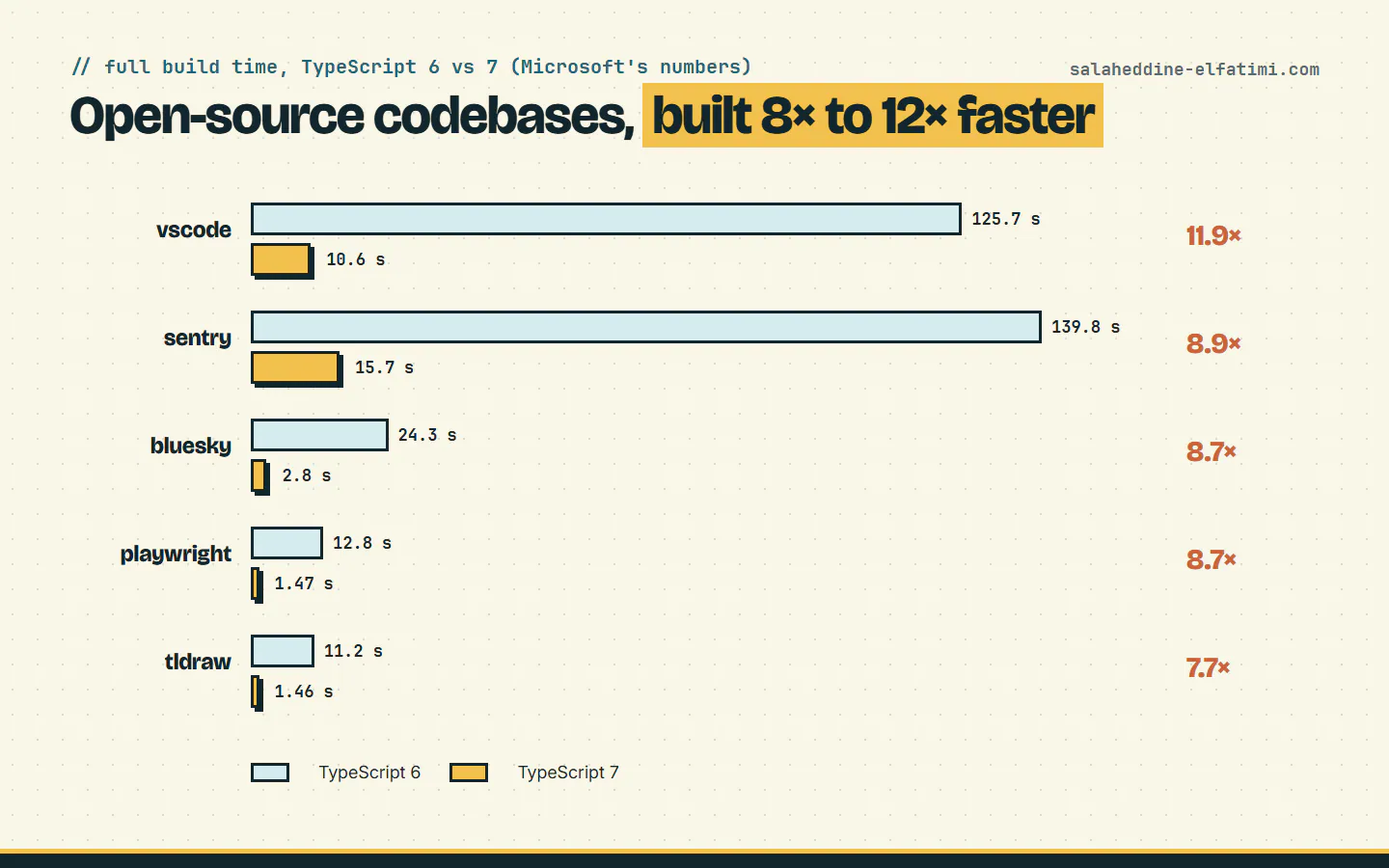
Microsoft built five large open-source codebases with TypeScript 6 and TypeScript 7 on the same machine:
Full build times from Microsoft's announcement: the VS Code codebase goes from 125.7 s to 10.6 s, Sentry from 139.8 s to 15.7 s.
VS Code: 125.7 s → 10.6 s (11.9×)
Sentry: 139.8 s → 15.7 s (8.9×)
Bluesky: 24.3 s → 2.8 s (8.7×)
Playwright: 12.8 s → 1.47 s (8.7×)
tldraw: 11.2 s → 1.46 s (7.7×)
Memory went down too, by 6% to 26% depending on the project. And the editor, where you spend your day, gains even more: opening a file with an error in the VS Code codebase used to take about 17.5 seconds before the first red squiggle. With TypeScript 7 it's under 1.3 seconds.
Before the release, companies ran it on their own code. The announcement quotes a few of them:
Slack: type-checking in CI went from about 7.5 minutes to 1.25 minutes, and the merge queue got 40% shorter. Their engineers could type-check locally again instead of waiting for CI.
Canva: the first error in the editor shows in about 4.8 seconds instead of about 58.
Vanta: builds up to 9× faster on one of their biggest projects.
The new language server is also more stable: Microsoft reports over 80% fewer failing commands and over 60% fewer crashes than TypeScript 6.
Keep in mind these are Microsoft's benchmarks and the quotes they chose to publish. Your gain depends on your project: a small Next.js site that already builds in a few seconds will feel less of a difference than a monorepo that takes minutes.
VS Code has a dedicated extension for TypeScript 7 that you can use today, and Visual Studio picks it up from your workspace. Nightly builds now come from the same package: npm install -D typescript@next.
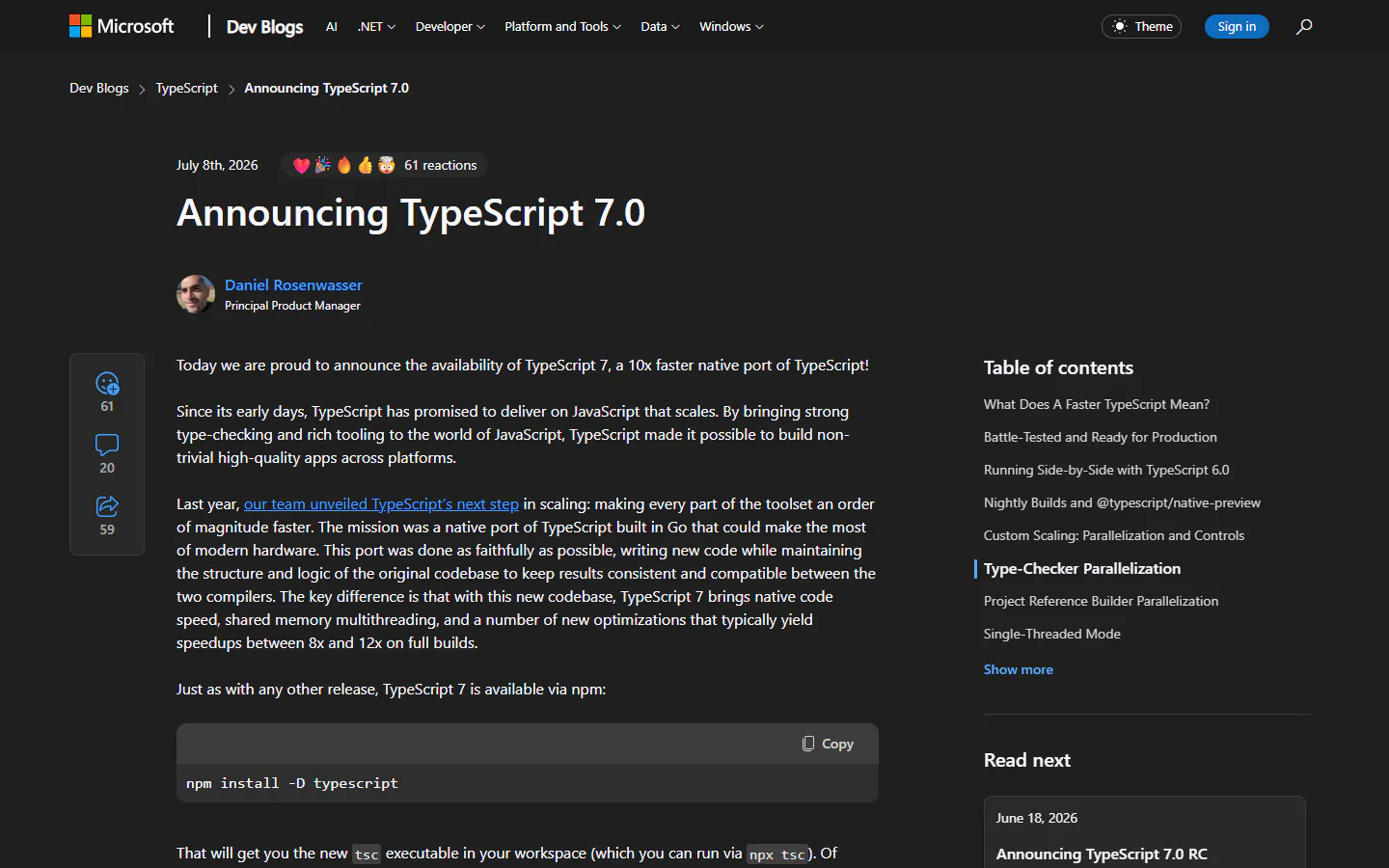
The official announcement on the TypeScript blog, 8 July 2026.
This is the catch. TypeScript 7.0 doesn't ship a programmatic API; a new, different one is planned for 7.1. Tools that import the compiler directly, like typescript-eslint, still need TypeScript 6. Microsoft published a compatibility package for that, which gives you a tsc6 command and re-exports the 6.0 API:
That alias leaves you with only tsc6. To keep TypeScript 7's tsc as well, the announcement shows a package.json with two aliases: "typescript": "npm:@typescript/typescript6@^6.0.2" for your tools, and "@typescript/native": "npm:typescript@^7.0.2" so that npx tsc runs 7.0.
There are also new flags to control the parallel work, marked experimental: --checkers (4 type-checking workers by default), --builders for project references, and --singleThreaded for debugging or small machines.