- E-learning
- Pricing
- Case study
- Next.js
How much does it cost to build an e-learning platform?
What an e-learning platform really costs: from about $1,000 for a focused first version, the features that move the price, and the monthly running costs after launch.

· 4 min read
Key takeaways
- 1E-learning platform cost depends on scope: a focused first version with only the must-haves starts from about $1,000.
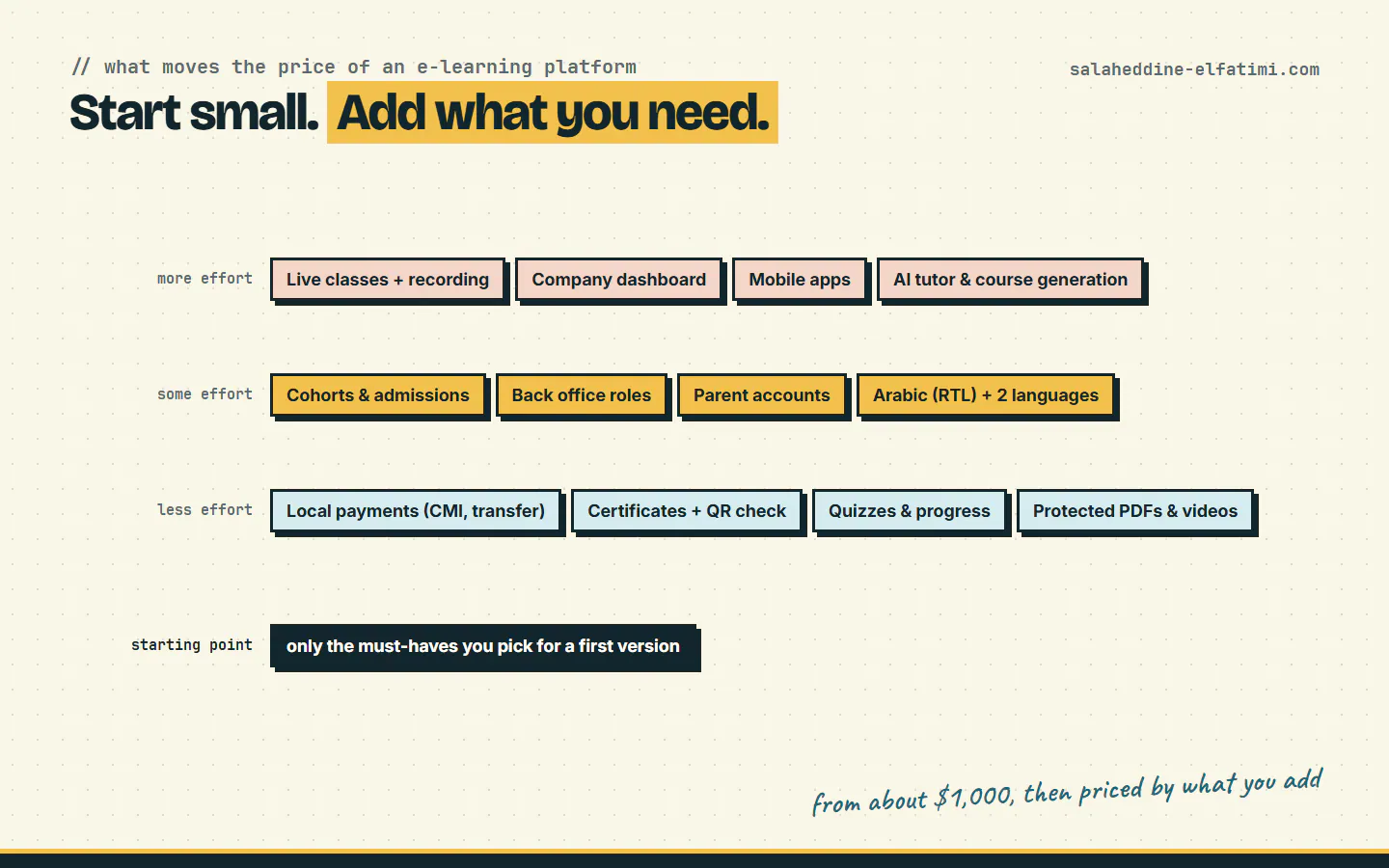
- 2Live classes, a company dashboard, mobile apps and AI features take the most effort; payments, certificates and quizzes take less.
- 3Running costs have six lines: server, live video, storage, email, payment fees and AI, each growing with usage.
- 4Starting small, using hosted services first and building one API from day one keep the first version affordable.
The e-learning platform cost depends almost entirely on which features you need. With me, a first version with only your must-haves starts from about $1,000, and the price grows with each module you add: live classes, local payments, cohorts, a back office, AI, mobile apps. Agencies publish much wider ranges. Below is what actually moves the price, based on the platforms I've built, and what a platform costs to run after launch.
Why e-learning platform cost estimates vary so much#
Search for LMS development cost and you'll find numbers that don't agree. AnyforSoft quotes anything from $8,000 to over $500,000, and Cleveroad gives its own breakdown by feature. Those figures come from agencies, with project managers, designers and several developers on every project, often priced for large companies.
The bigger reason is scope. "An e-learning platform" can mean a page that sells three video courses, or a system that runs live classes, admissions, payments, a staff back office and the company's finances. Both are e-learning platforms. They are not the same project, so asking for one price for both doesn't work.
What drives the cost: feature by feature#
This is the list I use to scope a project. Each line is something I've built for a real platform, so you can see it working before you decide you need it:
| Module | What it involves | Built for | Effort |
|---|---|---|---|
| Live classes + recording | Video in the browser, access by enrolment, recorder, replays | CCL, Schoolaris | More |
| Company dashboard | Quotes, HR and employees, finances in the same system | CCL | More |
| Mobile apps | iOS and Android on the same API as the website | Polypro, Schoolaris | More |
| AI features | AI tutor with a budget, course generation, voice practice | Schoolaris, Polypro | More |
| Cohorts & admissions | Sessions, seats left, admissibility letters | CCL | Some |
| Back office roles | Separate areas for admins, staff, teachers | CCL, Schoolaris, UpSkills | Some |
| Parent accounts | Parents follow each child's progress | Schoolaris | Some |
| Several languages | French, English and Arabic (right-to-left) | Schoolaris, Polypro | Some |
| Local payments | Stripe, CMI, bank transfer with proof of payment | Schoolaris, UpSkills | Less |
| Certificates | PDF certificates with a public QR or code check | CCL, UpSkills | Less |
| Quizzes & progress | Exams, pass marks, progress tracking | UpSkills, CCL E-Learning | Less |
| Protected content | Watermarked PDFs, signed video links | CCL E-Learning | Less |
Most first versions need three or four of these, not all twelve, and that choice sets most of the e-learning platform cost. The Schoolaris case study shows what a platform with most of them looks like once it's grown.
How much does a custom e-learning platform cost to run?#
Building it is one cost. Running it is a smaller, monthly e-learning platform cost, and it's worth knowing the lines before you launch:
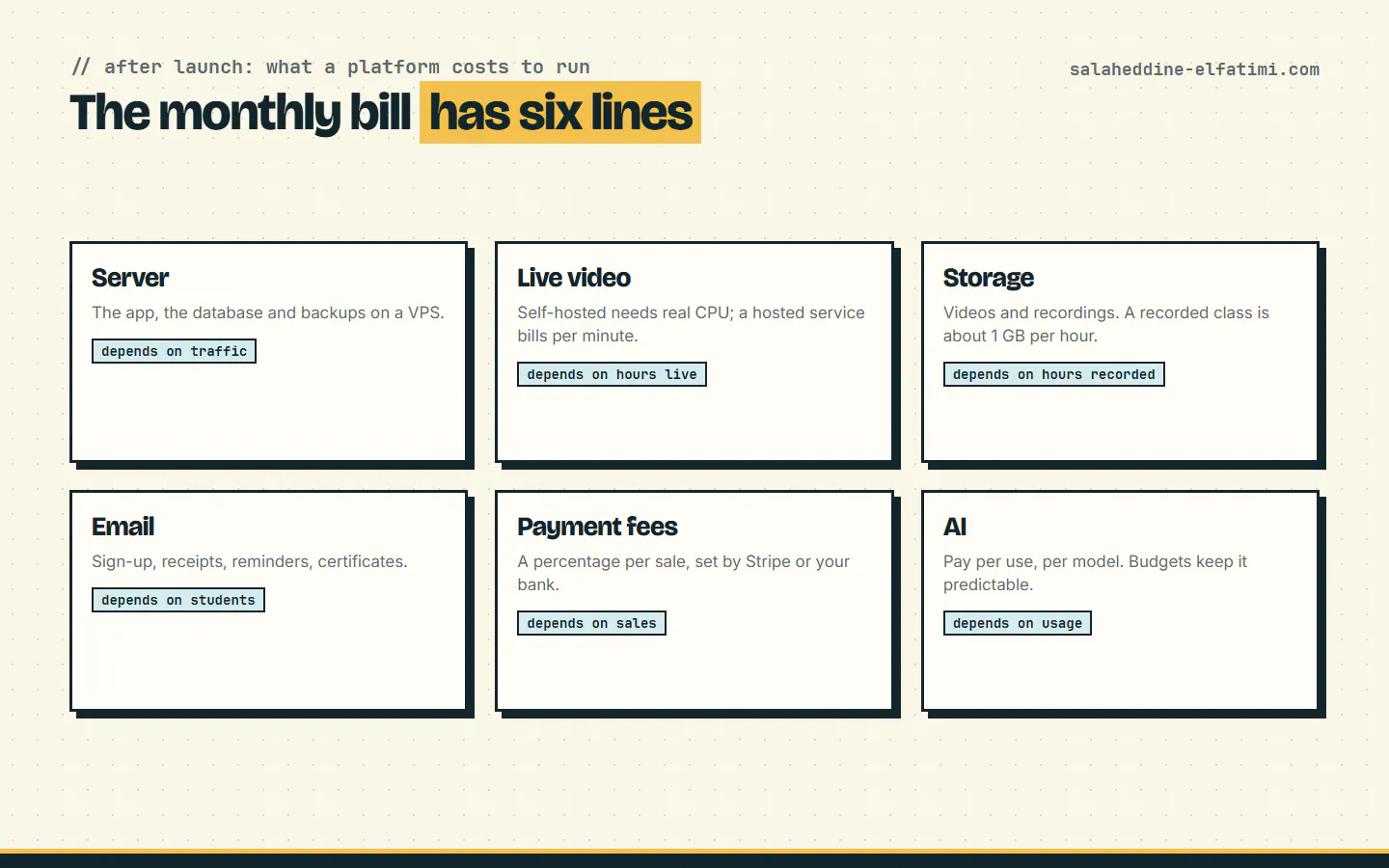
- Server. The app, the database and backups, usually on one virtual server. It grows with traffic.
- Live video. Self-hosted video needs a server with real CPU; a hosted service such as LiveKit Cloud bills per minute instead.
- Storage. Course videos and recordings. A recorded class takes about 1 GB per hour, so storage follows how much you record.
- Email. Sign-up, receipts, reminders and certificates, sent through an email service.
- Payment fees. A percentage of each sale, set by Stripe or your bank.
- AI. Billed per use. On the platforms I build, each AI call is logged with its cost and students get a budget, so the bill stays predictable.
For comparison, a SaaS platform bundles most of this into one subscription. CCL paid LearnWorlds $254.15 a month before it moved to its own platform. A custom platform replaces that with a one-time build plus its own running costs, and you own the result.
How to keep the first version affordable#
- Start with the must-haves. Launch with what your students need on day one; it's the simplest way to lower the e-learning platform cost. Everything in the table above can be added later without starting over.
- Use hosted services first. Hosted video, payments and email cost little at the start. Self-host a piece only when the volume makes it worth it, the way CCL self-hosted LiveKit once live classes became the core of the business.
- Build one API from day one. If a mobile app is likely later, a single API for the website and the app saves building everything twice.
- Keep live classes simple at first. If live sessions are occasional, a meeting link is fine. Build live classes into the platform when live teaching is what you sell.
What to prepare before asking for a quote#
A precise quote needs answers to a few questions. Having them ready saves a round of back-and-forth:
- Who are your learners, and how many do you expect in the first year?
- Recorded courses, live classes, or both?
- How will people pay: cards, local methods, bank transfer, subscriptions?
- Which languages, and does any of them read right to left?
- Who works in the back office: admins, staff, teachers, parents?
- Do you need certificates, and should employers be able to verify them?
- Are you moving from another platform, with students and content to bring along?
Get a price for your platform#
Projects start from about $1,000 for a focused first version, and every module is priced separately, so you only pay for what you use. Send me your answers to the questions above and I'll come back with a clear scope and price. You can also look at the platforms I've built first.
Frequently asked questions
How much does it cost to build an e-learning platform?+
It depends on the features. With me, a focused first version starts from about $1,000 and each extra module is priced separately. Agencies publish ranges from about $8,000 to over $500,000 for larger builds.
What makes an e-learning platform more expensive?+
Built-in live classes with recording, a company back office, mobile apps and AI features take the most work. Payments, certificates and quizzes add less.
What are the monthly costs of running an e-learning platform?+
A server, live video (self-hosted CPU or per-minute hosted), storage for videos and recordings, an email service, payment fees per sale and AI usage. Each one grows with how much the platform is used.
Is a custom platform cheaper than LearnWorlds or Teachable?+
Not always at the start. A SaaS plan is quick to launch; a custom platform replaces the monthly subscription with a one-time build plus running costs, and you own it. It pays off when you need features or rules a SaaS plan doesn't give you.
Written by
Full Stack Developer & Web Marketer · Marrakech, Morocco
I build modern, scalable web applications end to end, from frontend to backend, with a focus on performance, clean code and user experience.