Darija AI: Morocco and Mistral AI build models that understand Moroccan Arabic
Morocco's digital ministry and Mistral AI announced two Darija AI models: a dialect classifier and Voxtral speech recognition for Darija. What they do, why they matter, and when they'll be open source.
On 29 September 2026, Morocco's Ministry of Digital Transition and Mistral AI announced two AI models for Moroccan Darija.
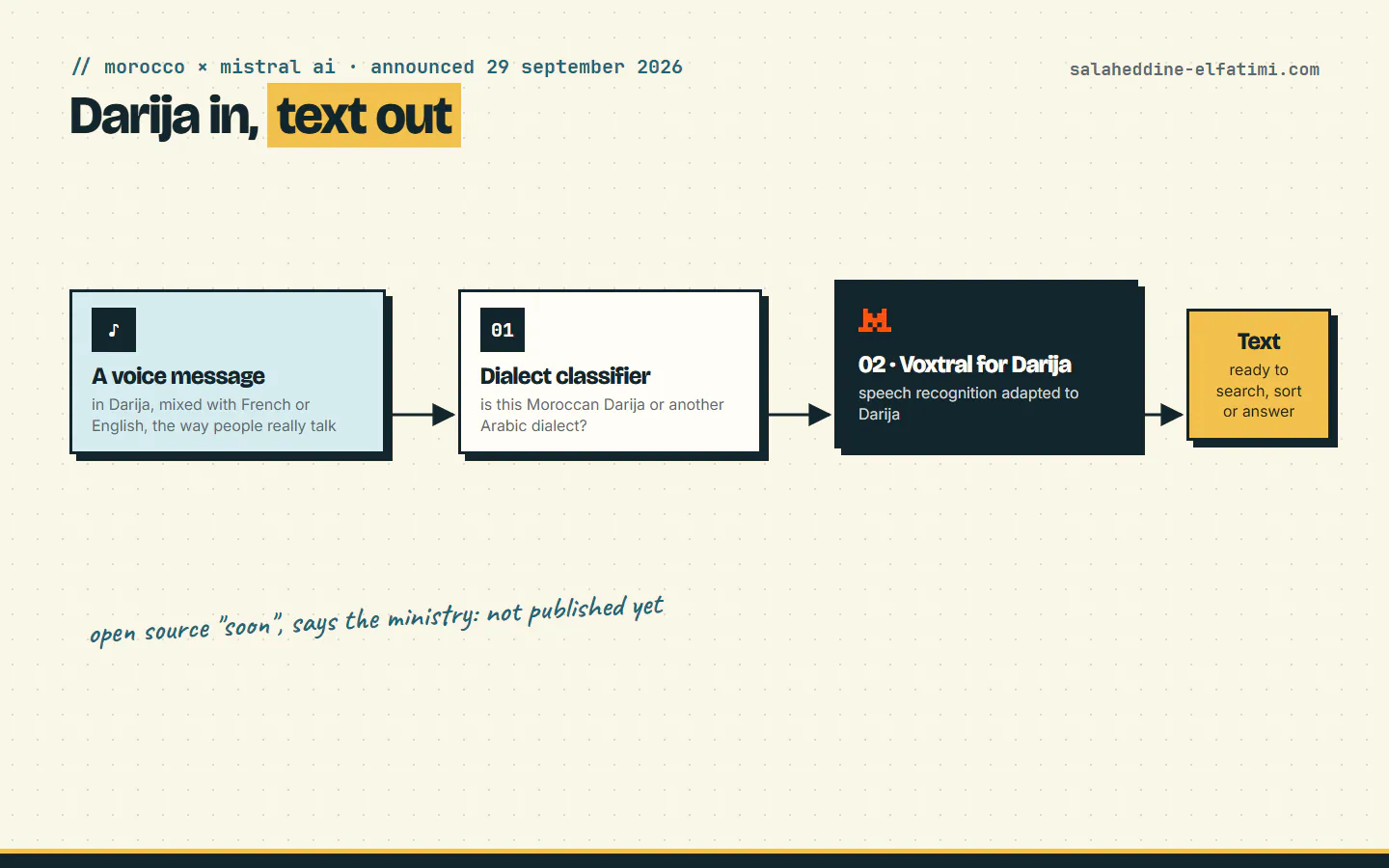
One identifies Arabic dialects including Darija; the other, based on Voxtral, turns Darija speech into text, even mixed with French and English.
The ministry says both will be open source soon; on 1 October 2026 they weren't published on Hugging Face yet.
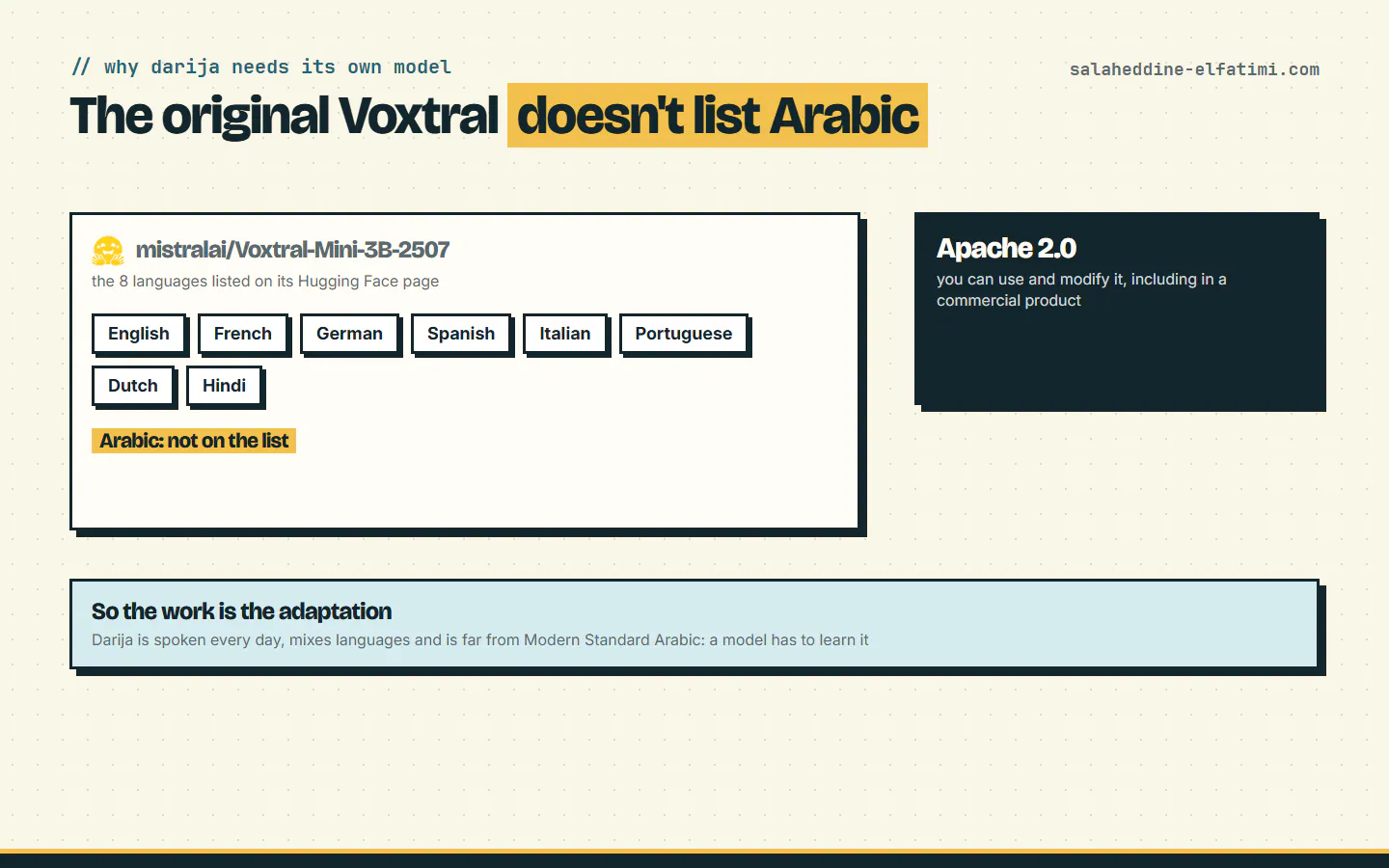
The base Voxtral Mini model is under Apache 2.0 and lists 8 languages, not Arabic, which is why the Darija adaptation matters.
Darija AI got a real push on 29 September 2026: Morocco's Ministry of Digital Transition and the French company Mistral AI announced two AI models built for Moroccan Darija. One recognises which Arabic dialect is being spoken; the other turns spoken Darija into text, even when it's mixed with French and English. The ministry says both will be open source soon.
Soon, not yet: on the day I checked, they weren't published. Here's what they do, why they matter, and what a business could build with them.
These are the first results of a multi-year partnership between the ministry and Mistral AI, under the Maroc Digital 2030 strategy and the "AI Made in Morocco" roadmap. Two models:
A dialect classifier. It recognises different Arabic dialects and tells Moroccan Darija apart from the others.
Voxtral adapted to Darija. Mistral's speech recognition model, adapted to turn Darija speech into text, including conversations that switch between Arabic, French and English.
The minister, Amal El Fallah Seghrouchni, called them concrete results of the roadmap:
Des réalisations concrètes de notre feuille de route AI made in Morocco qui vise le développement d'une intelligence artificielle utile, souveraine et adaptée aux réalités marocaines.
The ministry adds that more models are already in progress, in generative AI, language processing, speech recognition and digital public services.
Frequently asked questions
What Darija AI models did Morocco and Mistral AI announce?+
Two models: a classifier that identifies Arabic dialects and recognises Moroccan Darija, and a version of Mistral's Voxtral speech recognition adapted to turn Darija speech into text, including speech mixed with French and English.
Are the Darija AI models open source?+
Not yet. The ministry's statement of 29 September 2026 says they will soon be available as open source. On 1 October 2026 they weren't published on Hugging Face.
What is Voxtral?+
Voxtral is Mistral AI's family of speech models for transcription and audio understanding. Voxtral Mini 3B is published on Hugging Face under the Apache 2.0 licence and lists 8 languages, not including Arabic.
What can Darija AI be used for?+
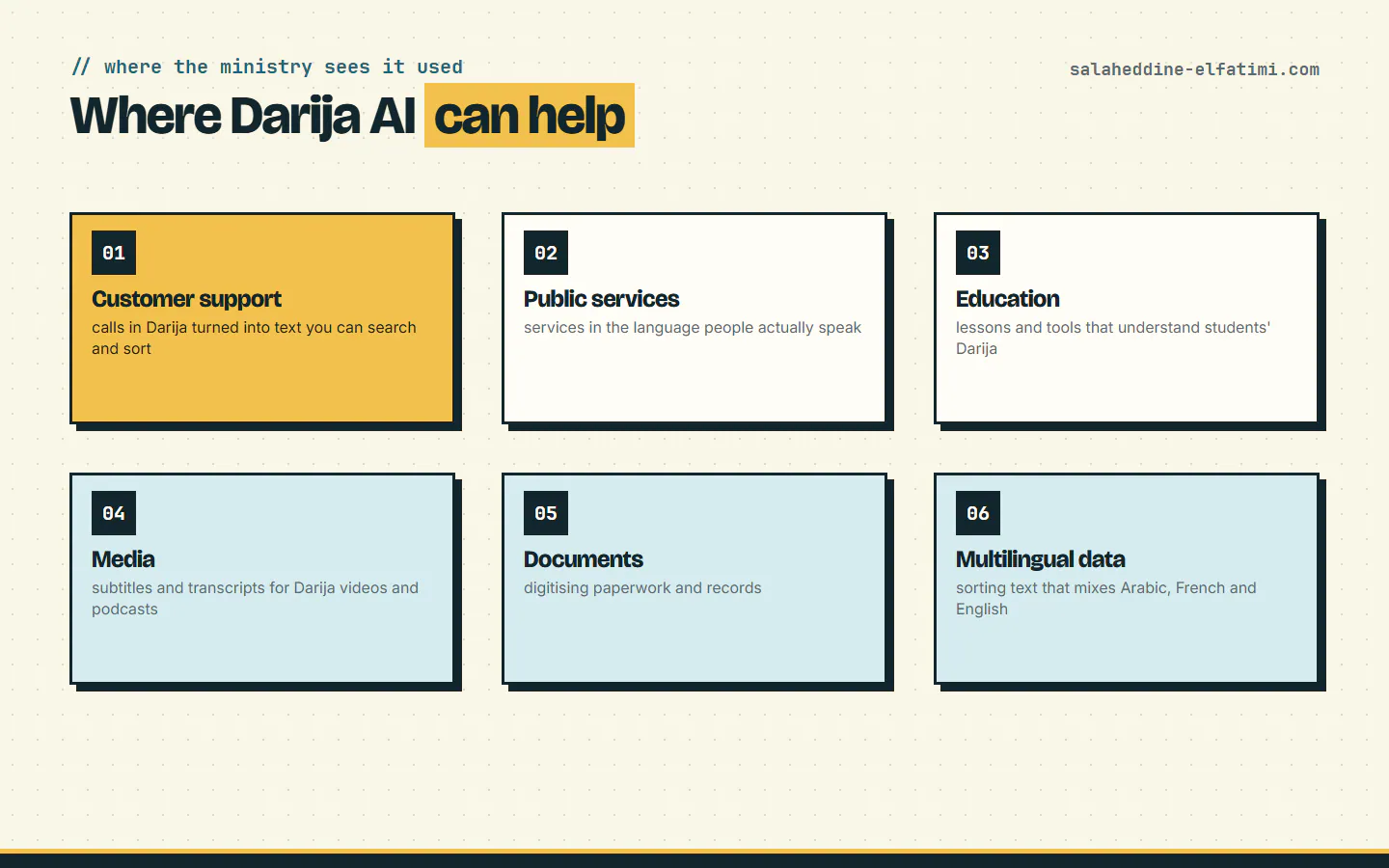
The ministry mentions public services, education, media, customer support centres, document digitisation and multilingual data. For businesses, turning Darija calls and voice notes into searchable text is the most direct use.
Most AI tools are trained on Modern Standard Arabic, if they handle Arabic at all. Darija is different: it's the language Moroccans actually speak, it borrows from French, Spanish and Amazigh, and in a normal conversation people switch languages mid-sentence. A model that hasn't learned that gets it wrong.
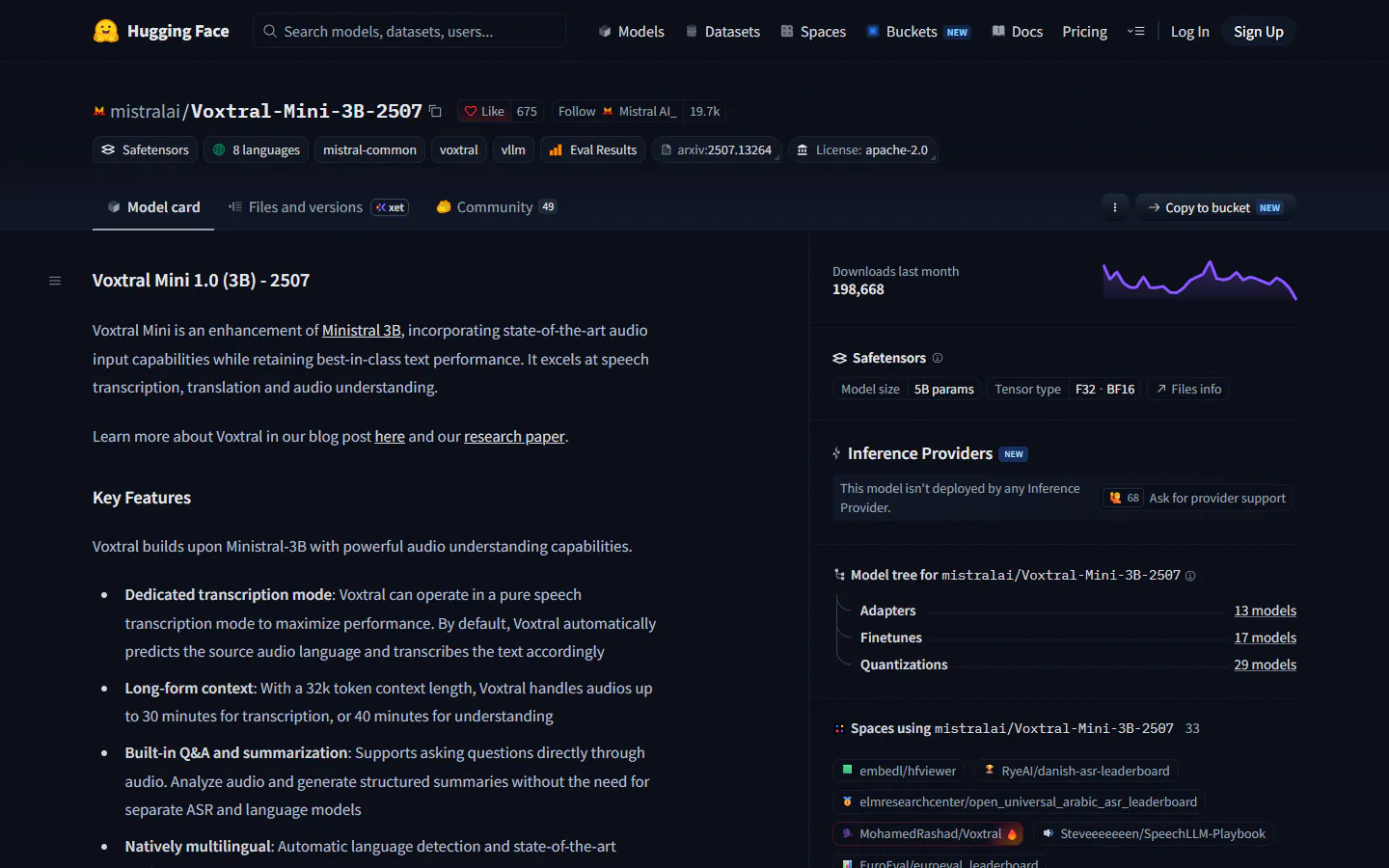
You can see the gap on Mistral's own model. The original Voxtral Mini page on Hugging Face lists eight languages: English, French, German, Spanish, Italian, Portuguese, Dutch and Hindi. Arabic isn't one of them. So the work here is the adaptation, not a brand-new model, as Ecofin points out.
The base Voxtral model lists 8 languages and no Arabic, under the Apache 2.0 licence.
I know the problem first-hand. The explainer videos on this site use an AI voice speaking Darija, and getting it to sound Moroccan instead of Egyptian or Gulf took a lot of rewriting, word by word. Recognition has the same problem in reverse: understanding Darija is harder than understanding the Arabic in the training data.
The ministry's wording is "soon". Its statement says the models "will soon be available" as open source, for administrations, startups, researchers, developers and companies.
Not on Hugging Face yet. On 1 October 2026 I found no Darija model from Mistral or the ministry on the Hub. Some articles wrote "released"; the ministry's own text says "soon".
The base model is already open. Voxtral Mini is published under Apache 2.0, which allows use and changes, including in commercial products. Whether the Darija versions keep the same licence isn't stated yet.
The Voxtral Mini 3B model page on Hugging Face, with its Apache 2.0 licence.
The areas the ministry mentions, from customer support to multilingual data.
Customer support: calls and voice notes in Darija turned into text that a team can search, sort and follow up.
Public services: services that work in the language people speak at the counter.
Education and media: transcripts and subtitles for lessons, videos and podcasts in Darija.
Documents and data: processing text that mixes Arabic, French and English.
For a small business, the first one is the most concrete. Many Moroccan companies run on WhatsApp voice notes and phone calls. If those could be written down automatically, they could land in a CRM as notes, be searched later, or be routed to the right person. Ecofin's caution is fair, though: for now these are possible uses, not systems running at scale.