TypeSafe AI's Jev: Typed AI Decisions for Code, Explained
TypeSafe AI's Jev answers your code with typed decisions and a confidence score, in milliseconds, for $42 per billion tokens. What it is, the code, and the fine print.
· 5 min read
Key takeaways
1TypeSafe AI's Jev is a 'System One Model': it returns typed decisions with a confidence score instead of text.
2Questions come in three types: Choice (pick an option), Score (a scale) and Noul (a 0–1 yes/no).
3TypeSafe quotes 70–500 ms per call and $42 per billion input tokens, with output free.
4By TypeSafe's own account, its 193.6× faster / 444.6× cheaper figures are on the high end, and the pricing can't yet be proven unsubsidized.
5Jev is invite-only for now, with a waitlist on typesafe.ai.
TypeSafe AI is a San Francisco AI lab that released Jev, which it calls the first public "System One Model". Instead of writing text like a chatbot, Jev answers questions your code asks with a typed decision and a confidence score, in 70 to 500 milliseconds, for $42 per billion input tokens. It's built for the small decisions inside software: route this message, is it urgent, is that AI answer correct.
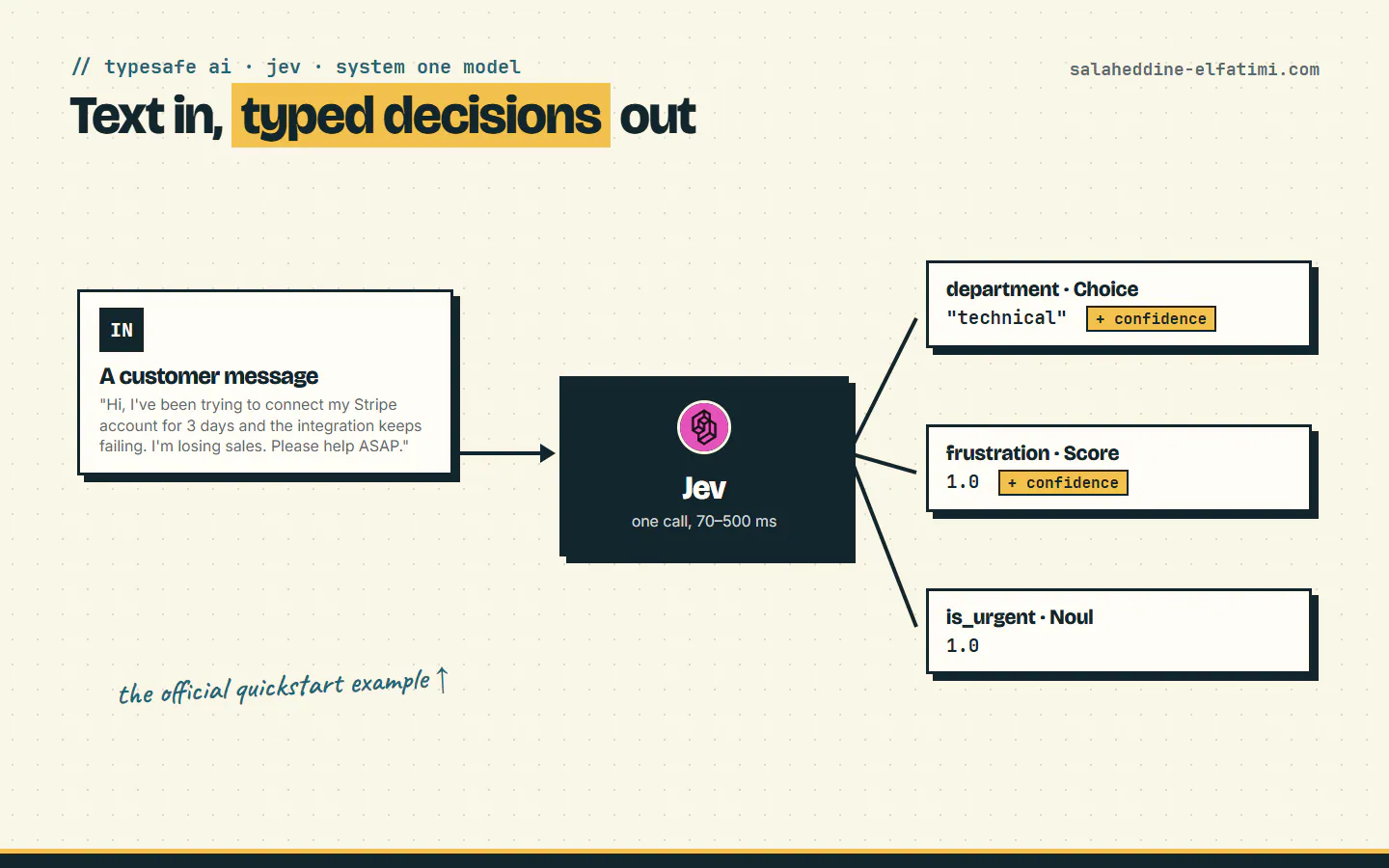
The official quickstart example: one call returns a team, a frustration score and an urgency value.
I read the launch post, the docs and the home page. Jev is invite-only for now, so I haven't run it myself yet: everything below is what TypeSafe publishes, with their own caveats included.
The name comes from the idea of fast, intuitive thinking ("System One") versus slow, deliberate reasoning. In the launch post, founder Diogo Almeida, who worked at OpenAI on the methods behind ChatGPT, describes it as "a new class of frontier models built to make fast, structured decisions that software can use directly."
His one-line summary: "Think of Jev as a frontier-intelligence function call: unstructured state in, typed probabilistic decisions out."
Chat models (LLMs)
System One + Jev
Frequently asked questions
What is TypeSafe AI?+
A San Francisco AI lab, founded by Diogo Almeida, that builds 'System One Models': AI models that give software typed decisions with confidence scores instead of generated text. Its first public model is Jev, launched on 15 September 2026.
Is Jev a chatbot or a smaller LLM?+
No. Jev doesn't generate text. You send it text and questions with predefined answer types (Choice, Score, Noul) and it returns the answers with probabilities and a confidence.
How much does Jev cost?+
TypeSafe lists $0.042 per million input tokens ($42 per billion) with output free. The company says it can't yet prove the price isn't subsidized and expects it to go down.
Can Jev be wrong?+
Yes. 'Zero hallucinations' refers to type safety: the answer is always one of the allowed values. The answer itself can still be wrong, which is what the confidence score is for.
A chat model that's right 95% of the time is hard to automate with if it doesn't tell you when it's in the other 5%. TypeSafe's pitch is that Jev's confidence is calibrated: "higher confidence means higher accuracy". So your code, not the model, draws the line: above your threshold it acts on its own, below it a person takes a look.
You pick the threshold: confident answers are handled automatically, the rest go to a person.
The home page headline is "193.6x Faster, 444.6x Cheaper", with a side-by-side run: $0.000081 and 0.114 s for Jev against $0.013880 and 8.566 s for an LLM. It also says Jev's input price is "238x Lower" than Claude Fable 5.1's (Fable is $10 per million input tokens; Jev $0.042).
To TypeSafe's credit, the launch post spells out the limits of these claims:
The 193.6× and 444.6× figures are, in their words, "on the higher end of real world gains".
On price: "We can't prove it isn't subsidized".
The workflow evals were made by their own team, "so some bias could exist", and speed was measured from the US West Coast, where the service runs.
"Zero hallucinations" means no type errors: the answer is always one of the allowed values. Their own FAQ still asks "Can Jev still get things wrong?", which is why the confidence score matters.
The launch post, 15 September 2026, with the benchmarks and the caveats.
The launch post lists "smart if-statements" inside workflows, map-reducing over big data, real-time features, and checking other AI output ("score, judge, verify, guardrail"). Translated to the projects I build:
Routing incoming messages: a contact form or WhatsApp message goes to sales, support or billing, with urgent ones flagged first.
Checking a chatbot's answer before a customer sees it: is it on topic, does it promise something it shouldn't?
Tagging a backlog: thousands of tickets or reviews sorted by topic and mood for the price of a coffee.
For anything that needs writing (a reply, a summary, code), you still need a chat model: Jev "gives up string generation" by design. The interesting setup is both together, with Jev making the fast yes/no and routing decisions around the slower model.
Jev launched in early access, and the home page now says "TypeSafe is invite-only again", with a waitlist. Existing users can log in to the console and the Playground. The docs, including a guide for coding agents, are public at docs.typesafe.ai.
The TypeSafe AI home page, with the waitlist box.
I'll test it on a real routing workflow once I get access and write up the results. Meanwhile, if you want AI inside your platform, like a CRM that sorts its own messages or a support inbox that knows what's urgent, tell me about your project. More AI notes: September's developer news and what WebMCP is.