- AI
- OpenAI
- AI news
OpenAI dots: always-on AI agents that keep working for you
OpenAI dots are always-on agents with their own cloud computer, launched at DevDay 2026. How they work, what they can do, who can use them, and the fine print.
OpenAI dots are always-on agents with their own cloud computer, launched at DevDay 2026. How they work, what they can do, who can use them, and the fine print.
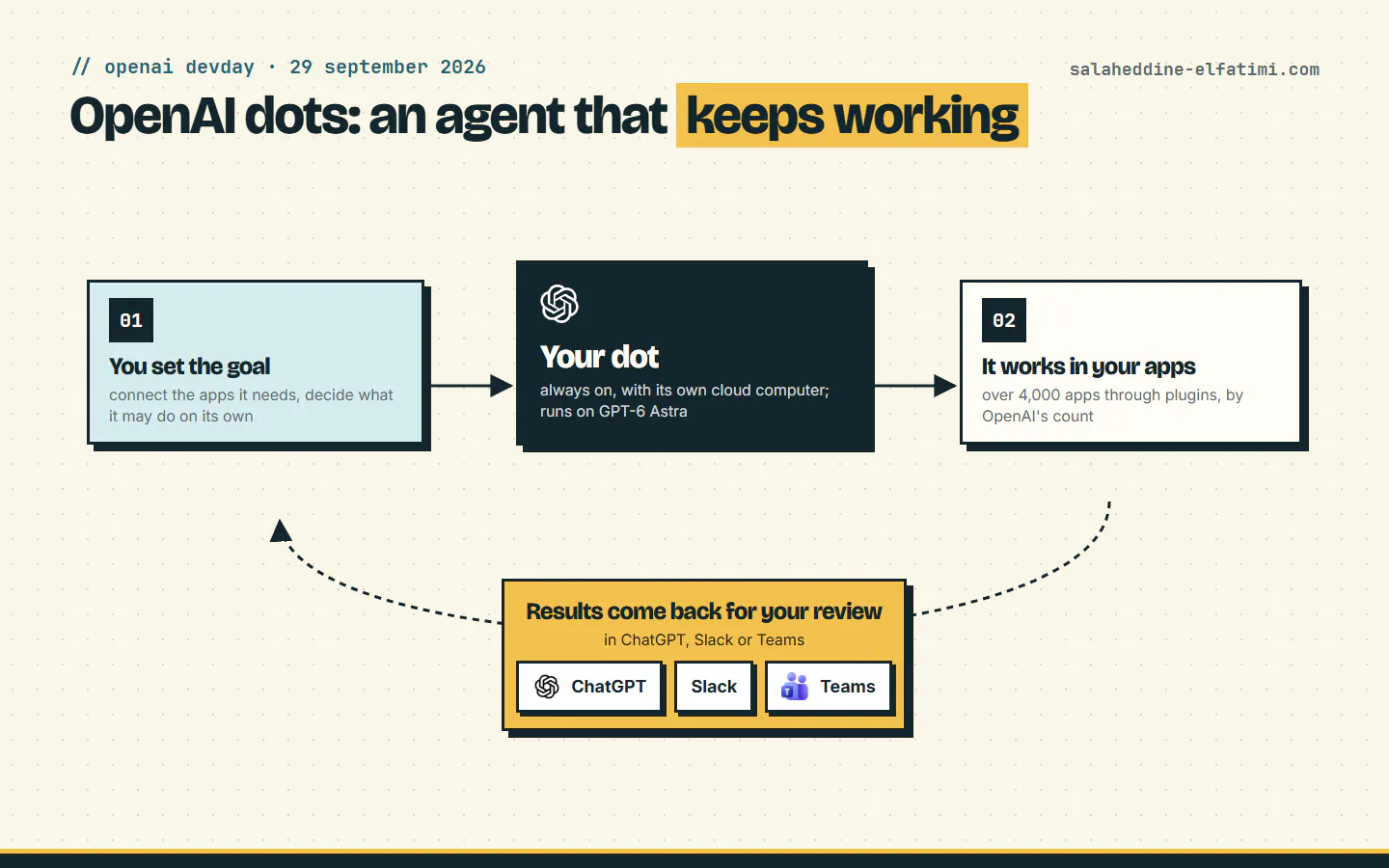
Dots are always-on AI agents in ChatGPT, announced at OpenAI DevDay on 29 September 2026. Each one runs on GPT-6 Astra, has its own cloud computer, and keeps working on a goal you give it between conversations.
At launch, eligible ChatGPT Pro and Business Premium users aged 18 and over in supported markets, with one dot included. Enterprise workspaces can try it with admin approval. Pro access excludes the EEA, Switzerland and the UK at launch.
In ChatGPT, Slack or Microsoft Teams, and by voice call. You create it in the ChatGPT desktop app or the browser, then you can also use it from the mobile app. OpenAI says text messaging is coming later.
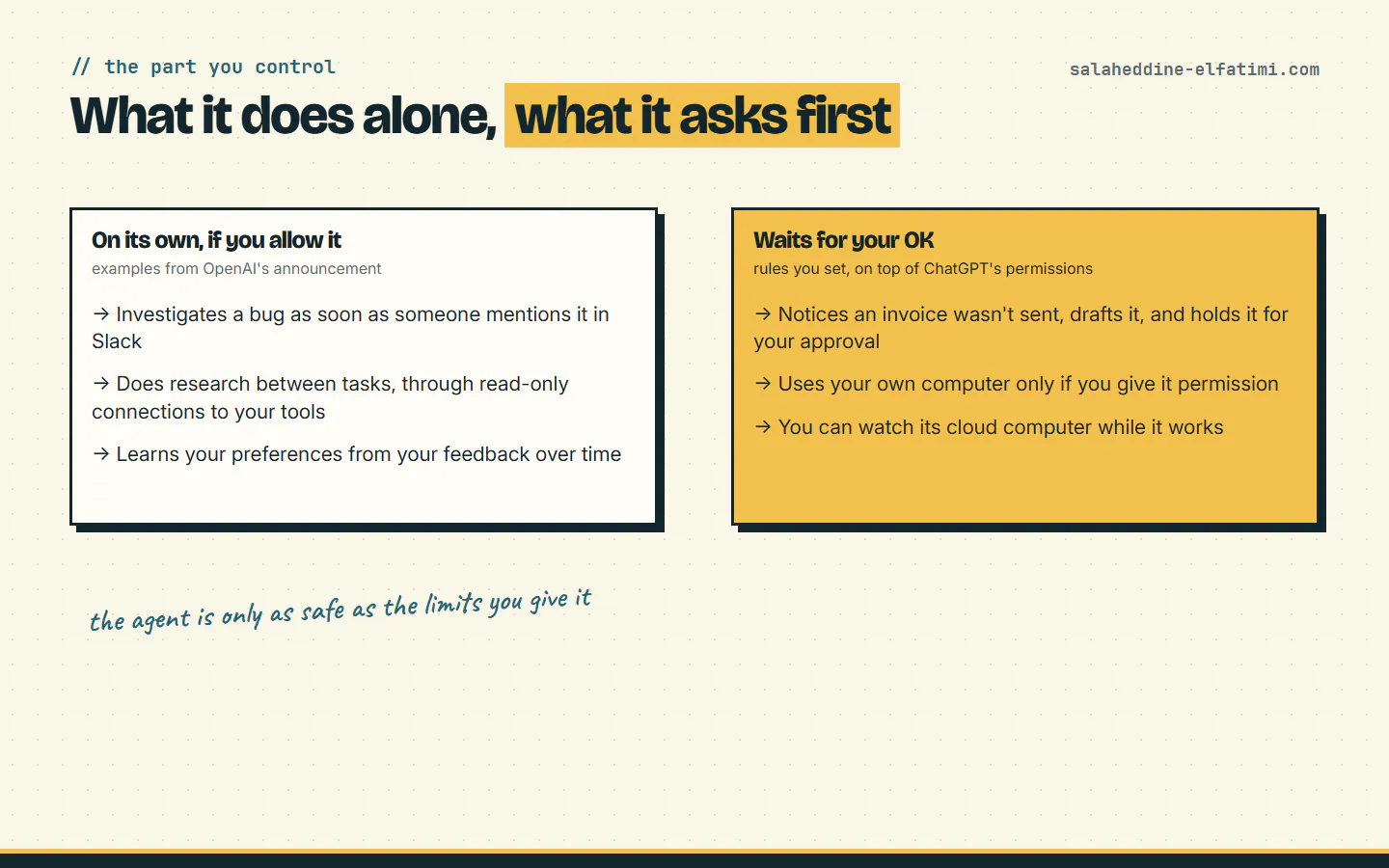
Only as far as you allow. Dots follow ChatGPT's permissions plus custom rules you set on when they can act alone and when they must ask you first. They can use your own computer only with your permission.

OpenAI dots are always-on AI agents that keep working after you close the chat. Announced at OpenAI DevDay on 29 September 2026, each dot runs on GPT-6 Astra, has its own cloud computer and, by OpenAI's count, can connect to over 4,000 apps.
You give it a goal, decide what it may do on its own, and it brings results back for your review. For now dots are only on ChatGPT Pro and Business Premium, and Pro isn't available in Europe or the UK at launch.
Until now, ChatGPT worked when you talked to it. You asked, it answered, and the work stopped when you left. A dot is different: it's an agent with a standing job. It keeps going in the background between conversations, and it comes back to you when it has something, or when it needs your OK.
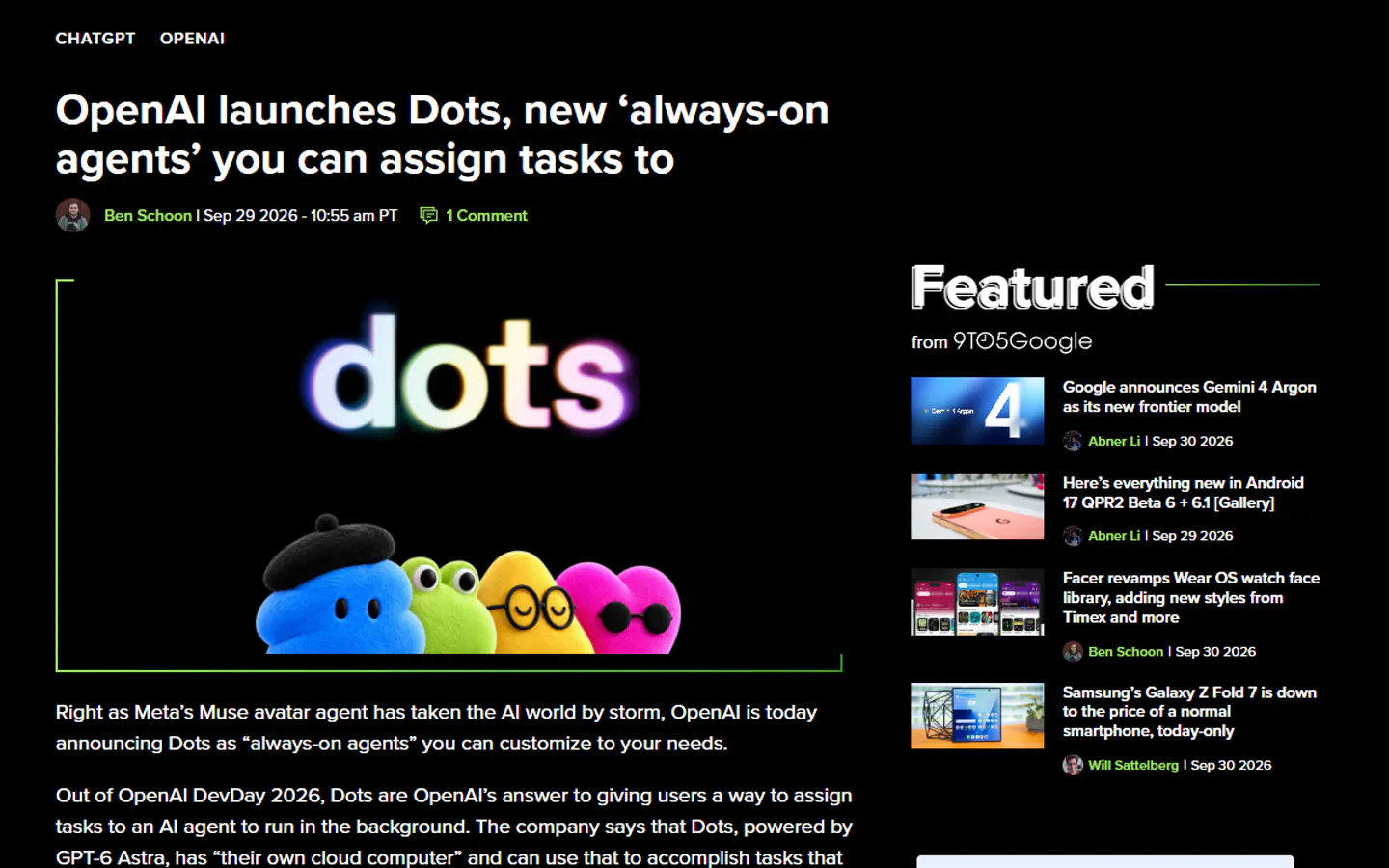
OpenAI describes them like this, as quoted by 9to5Google:
Dots are frontier intelligence that have your back. Powered by GPT-6 Astra, they have their own cloud computer, learn from feedback over time, and can work towards your goals 24/7.
OpenAI's CFO Sarah Friar put it more simply to CNBC: it's "the agent that can tap you on the shoulder". You give it a name, make it your own, and talk to it in ChatGPT, Slack or Microsoft Teams, or on a voice call.
The more you correct it, the more it learns how you like things done. That's the promise, at least; it's also why the third step matters most.
OpenAI shared examples from its own teams. Two stand out because any business owner will recognise them:
OpenAI's longer-term picture is a team of them: "Over time, we envision teams of Dots working together on your behalf," the company said, according to TechCrunch. One dot watches feedback, another fixes bugs, a third chases payments.
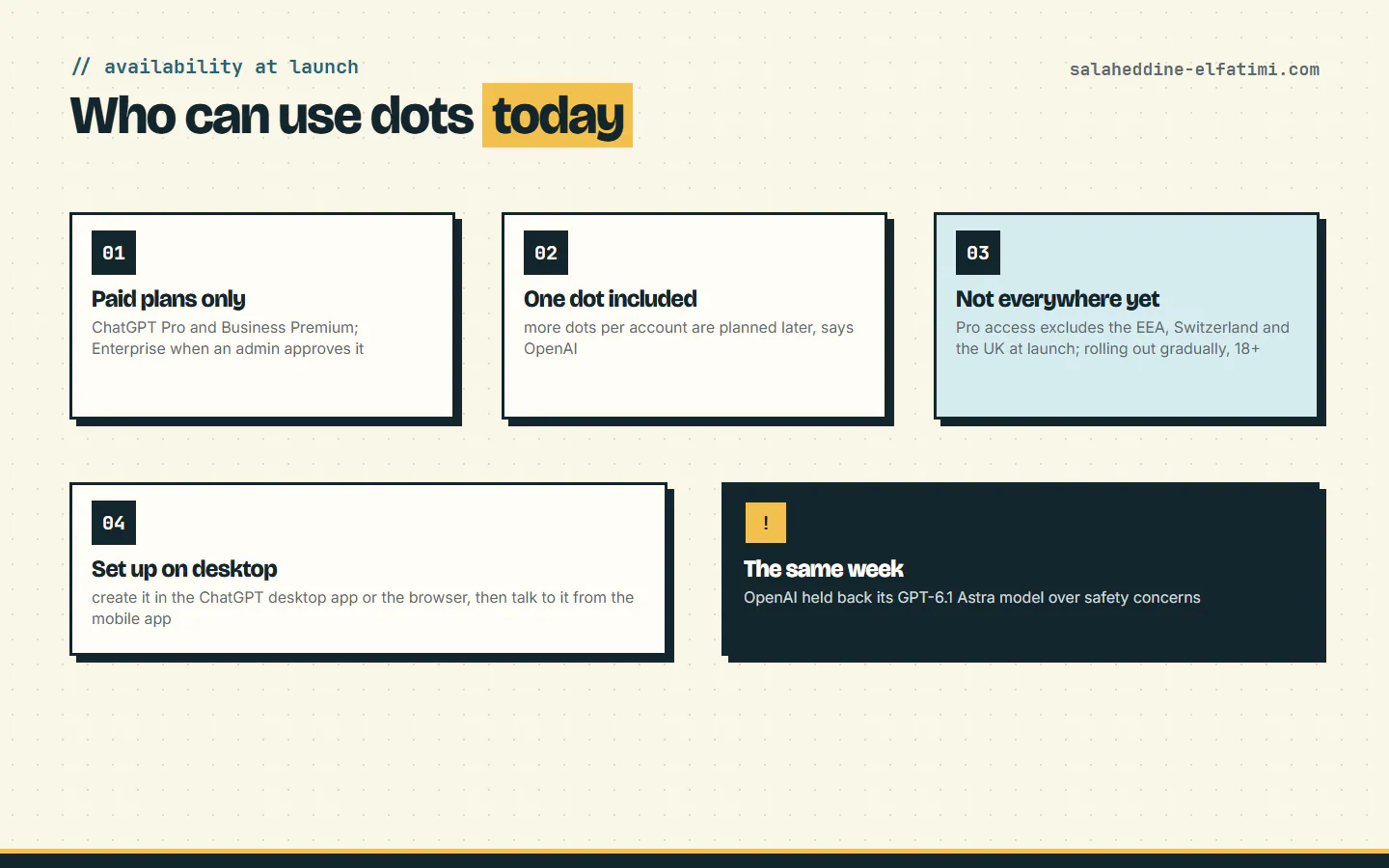
The launch came in a careful week for OpenAI. At the same DevDay, CNBC reported, the company explained why it held back its newest Astra model (GPT-6.1 Astra) over safety concerns, after disclosing incidents where its models behaved in unintended ways. Dots run on the earlier GPT-6 Astra.
It's also fair to say that not everything here is new. As TechCrunch points out, much of it was already possible with Codex and similar agent tools. What dots add is the package: always on, one place to talk to it, and a friendly face (the little characters you see in the launch images).
So the useful question isn't "is the agent smart?" but "what is it allowed to touch?". An agent that can draft an invoice is helpful. One that can send it, refund a client or reply to a customer without asking is a different decision. Start with read-only access and approvals, and widen them once you trust what you see.
I haven't used dots myself yet. When I do, I'll write up what it's like in practice.
Most of the examples above are things a small team forgets every week: the invoice nobody sent, the customer message nobody answered, the report nobody updated. An agent that watches for those and prepares the work is genuinely useful, as long as the information it needs is somewhere it can read.
That's the catch for many businesses: the leads are in a WhatsApp chat, the payments in a notebook, the clients in a spreadsheet. An agent can only follow up on what's written down in a system it can reach. Getting your data into one clean place comes first; the agent comes after.
I build custom CRMs and business tools that keep your clients, leads and payments in one place, with the access rules you choose. That's exactly what an agent like a dot needs to be useful. If you want to talk about it, get in touch. For another kind of AI built into business software, see TypeSafe AI's Jev, a model that sorts messages instead of chatting.


